18.43
'Информационная война России вступает в новую фазу. Поскольку ЕС ограничил деятельность RT, Sputnik и других российских государственных СМИ в Европе, Москва переключила внимание на страны Глобального Юга, инвестируя в обучение иностранных журналистов, программы журналистики с использованием ИИ, курсы медиаграмотности и профессиональные сети в Африке, Азии, Латинской Америке и на Ближнем Востоке. Если раньше целью было распространение российских нарративов в Европе для влияния на политиков и население в целом, то теперь задача состоит в формировании неевропейской медиасреды, через которую освещаются события, касающиеся Европы, Украины, НАТО, санкций и меняющегося международного порядка. Такие организации, как SputnikPro и RT Academy, сочетают обучение, культурную дипломатию, производство медиаконтента с использованием ИИ и наставничество со стороны государственных СМИ, эффективно создавая долгосрочную информационную архитектуру ‘серой зоны’, которую трудно разрушить. ЕС следует рассматривать подготовку журналистов, инструменты искусственного интеллекта и партнерство со СМИ в странах Глобального Юга как продолжение нового информационного ‘серого фронта’ России', – июньский доклад британского журнала Global Policy о наших успехах.
Sat 27 Jun 2026 08.01 BST
All quiet on the eastern flank? Nato leaders fear they can no longer rely on US help if Russia attacks.
Trump administration’s rhetoric has created so much uncertainty that Poland and Baltic states have fresh doubts as alliance prepares to meet next month.
Anightmare scenario has been playing on eastern European minds with increasing intensity since Donald Trump returned to the White House: what if Russia attacks and the US does not join the fight?
On the rare occasions the question is posed out loud, nobody much likes the answer. In mid-May, at a gathering in Tallinn, the US undersecretary of state Thomas DiNanno was asked directly whether American troops would fight if Russia invaded the Baltic states. He shifted uncomfortably in his chair, then gave a meandering answer. It did not include the word “yes”.
Politicians from the region usually try to sidestep the issue in public, claiming Washington’s commitment to Nato allies remains strong, and the alarming rhetoric from the Trump administration should not be taken to heart. “We shouldn’t pour fuel on the fire” is a mantra that was repeated in interviews by ministers from several countries on the eastern flank, where proximity to Russia infuses security debates with extra intensity.
Others admit that things are fraught between Europe and the US, but say a break in relations is out of the question, because the security gaps if the Americans absconded would be unbridgeable. Dovilė Šakalienė, a former Lithuanian defence minister, compared the relationship to “a dysfunctional family where divorce is not an option”.
In private, informal conversations are taking place in whispers. What would the response to a Russian attack look like if the US did not show up? Should Europe be doing everything to keep Trump on side – or be drawing up plans for the event that Washington does not come through? And will Vladimir Putin look at the unease in Nato and decide it is the perfect time to test the alliance’s resolve?
This account tracks the discussions in the eastern half of Europe during the 18 months since Trump took office for a second term, and shows how the prevailing mood has morphed from cautious approval of his demands for Europe to spend more into real doubts over US commitment to collective defence. It draws on interviews with dozens of officials in multiple countries, including national leaders, foreign and defence ministers, intelligence bosses and diplomats, many of whom spoke without attribution to discuss one of the most sensitive current foreign policy debates.
Ultimately, it is a psychological question as well as a geopolitical one. Eastern Europe has been one of the world’s most pro-American regions since the fall of communism. Poland joined Nato in 1999, the three Baltic states joined in 2004, and US security guarantees have been a fundamental part of national defence strategies ever since. Now, these countries face the possibility they might be abandoned by their primary ally.
One senior official in the region described a sense of bemused disillusionment: “What do you do when your beloved father figure suddenly starts drinking and behaving in a way that is utterly incomprehensible? It’s hard to know how to act.”
_________________
The first warning shots came in February 2025, less than a month into Trump’s second term, when the US defence secretary, Pete Hegseth, visited Nato headquarters in Brussels. In remarks laced with disdain, Hegseth told allies that in a world where China was on the rise, European security would no longer be a priority for Washington. Europe had to step up and pay for its own defence, said Hegseth, and the US would seek to withdraw from much of its stake in the continent’s security. It was an unwelcome reality check for many Europeans, who had hoped Trump’s second term would be much like his first – fiery rhetoric but little real policy change.
Hegseth chastised Europeans for making lofty speeches about values while expecting Washington to foot the bill. “Values are important, but you can’t shoot values, you can’t shoot flags, and you can’t shoot strong speeches. There is no replacement for hard power,” he said.
The ministerial meeting was followed by an informal lunch discussion. As the ministers ate, seated at tables arranged in a large square, the German defence minister, Boris Pistorius, told Hegseth that Europeans needed a timetable for the US drawdown, so they knew how long they had to fill the gaps. The idea was not popular in the room.
“Lots of us were upset with Pistorius,” said one European official who was present. “The feeling was that the Americans haven’t even made their mind up yet, so don’t tempt them with an idea that might actually push them into it and speed things up.”
Many from the eastern part of Europe felt there was a positive way to view Hegseth’s message. After all, Poland and the Baltic states had been pushing western European nations to increase their defence spending for years. If Europe could step up and prove it was willing to spend more, the Americans would stay engaged and the continent would be safer, went the thinking.
“Europe had avoided, lagged behind and procrastinated for decades, so that cold shower was justified and necessary,” said Šakalienė, Lithuania’s defence minister at the time, recalling Hegseth’s demands.
Hegseth’s aggressive messaging on Ukraine was harder to swallow. Two weeks later, Trump humiliated the Ukrainian president, Volodymyr Zelenskyy, during a televised White House showdown. Soon after, the US administration halted intelligence-sharing with Ukraine. The cutoff was reversed after little more than a week, but it left a lasting impression, demonstrating that the normal boundaries and frameworks of diplomacy had been tossed into the bin. The moment had a particular impact on the Polish prime minister, Donald Tusk, and his inner circle. “It felt like the ground shifting beneath their feet,” said one well-connected source in Warsaw.
One senior European official remembered raising these concerns directly to the then US national security adviser, Mike Waltz, on a trip to Washington. The official asked Waltz how the US could abandon Ukraine in the middle of a war, and said senior military officers at home, who had served with American forces in Afghanistan, felt betrayed and doubted whether Washington was still a reliable ally. Waltz said Ukraine was different, and that such a decision would never be taken with regards to a Nato ally. The official pushed back, pointing out that credible deterrence was based largely on perception: “I said to him: ‘In these kinds of discussions, what people believe is almost more important than what the reality would be.’”
_________________
Afew days after the Oval Office debacle, Keir Starmer gathered the leaders of a group of countries that would become known as the “coalition of the willing” in London. In public remarks, the attenders tried to minimise what had just transpired in the White House. But inside the room at Lancaster House, there was a feeling that something had broken. “I could see it on the faces of all these leaders – no matter if they were from the left or right, it was clear they understood that the world had changed,” said one person present.
After the London meeting, the format continued with regular video calls. The discussions ostensibly focused on coming up with a viable post-deal security arrangement for Ukraine, but the subtext was about how to keep Trump engaged in European security more broadly. At each meeting, the leaders would discuss which of them would be seeing or speaking to the US president in the coming days.
“We’d coordinate the messages and think about how to spin it to Trump in a positive way, think about the best way to manoeuvre him on to the right side,” said a source who was on many of the calls. Nato’s Dutch secretary general, Mark Rutte, as well as the leaders of Britain, France, Germany and Italy, had most access to Trump. Countries on the eastern flank were marginalised in these discussions, but Finland’s president, Alexander Stubb, had built up a rapport with Trump on the golf course, and acted “as a kind of ambassador for all the smaller countries”, said the source.
In June, the annual Nato summit took place in The Hague, amid apocalyptic predictions that Trump could use it to sound the death knell of the alliance. “Everyone was trying to share some bad scenario of how it will go, that it would be awkward, or bananas,” said one senior official who attended.
In the end, the summit was as a success, largely thanks to the efforts of Rutte, who had made it his personal mission to keep Trump happy. Member states committed at the summit to raise defence their spending to 5% of gross domestic product by 2035 – a level already approached by Poland and the Baltic countries, but previously unthinkable even as a future target for many western European nations. Rutte made it clear this was Trump’s personal achievement, delighting the US president. Rutte’s fawning, including calling Trump “daddy” on the sidelines of the summit, was seen by many as distasteful but tolerable. “It’s cringe, but most European leaders are fine with it as long as he delivers Trump,” said one Nato official.
The summit’s afterglow allowed some in eastern Europe to make the case again that Trump could turn out to be a net positive for the region’s security: the messaging might be chaotic and aggressive, but it had succeeded in forcing the reluctant western and southern Europeans into spending increases. “Barack Obama and Joe Biden asked politely for Europeans to spend more and it got us nowhere,” said the former Estonian president Kersti Kaljulaid. “It is only by being impolite and insistent that you can get Europe to change.”
The problem, which would continually undermine such positivity, is that in the world of Trump, a firm promise today can be undone by a Truth Social post tomorrow. The stated US strategic goal of a shift away from Europe was unwelcome but theoretically manageable; the chaotic and unpredictable implementation was harder to deal with.
For smaller states in particular, the peculiarities of Trump’s court can also cause problems with access. Ordinary communication channels do not work, US ambassadors often have little sway in the White House, and the circle of real decision-makers around Trump is so small that it is hard to gain influence over or insight into their thinking.
“In Trump 1.0 we had nothing to complain about,” said Artis Pabriks, a former defence and foreign minister of Lativia. “People in the Pentagon and state department understood our needs very well. Now it’s completely different. We can’t get to deliver our message, we cannot predict, we cannot talk.”
_________________
In September, about 20 Russian drones entered Polish airspace on a single night, in what appeared to be a calculated escalation and a test of Nato’s red lines. The alliance’s US chief commander in Europe, Alexus Grynkewich, liaised with Polish military headquarters in real time, opening up corridors for Dutch F-35 pilots to join Polish F-16s in the sky and shoot down many of the drones. “All sides try to compensate for the political situation with the quality of ties at a technical level,” said Sławomir Dębski, a Polish analyst and historian.
The political messaging was more questionable. As the attack was unfolding, Trump posted an excited “Here we go!” on social media; he later suggested it “could have been a mistake” rather than a deliberate attack. In a rare rebuke, top Polish officials said publicly that Trump was wrong. “You can believe that one or two veer off target, but 19 mistakes in one night, over seven hours, sorry, I don’t believe it,” Poland’s foreign minister, Radosław Sikorski, told the Guardian at the time.
In January, the next crisis moment emanated from Washington, not Moscow, when Trump doubled down on threats to annex Greenland from Denmark, a fellow Nato member. Some national capitals wrote alarmed requests to their missions asking for clarification on what would happen if Trump made good on his threats – could Denmark invoke article 5 of the North Atlantic treaty? Nato had not been designed for a scenario in which one member threatened another. One Nato diplomat described the feeling of those days as like looking into an abyss.
The Greenland scare passed, partly with the help of more deft and fawning diplomacy from Rutte, but it was followed by Trump’s war on Iran. The new engagement in the Middle East has led to delays in US weapons deliveries to European allies and has contributed to the chaotic messaging on European security. In mid-May, Poland was shocked to learn that a rotation of 4,000 US troops scheduled to be deployed to the country imminently had been cancelled. Some had already arrived when the announcement was made. “We’re trying to find out what’s happening, but it’s hard to find an American who knows what’s happening,” said one official at the time.
Trump soon reversed the cancellation via a Truth Social post, saying he was doing so because of his friendly ties with Poland’s nationalist president, Karol Nawrocki, who is at odds with the Tusk government. The implication was that troop levels could depend on Trump’s personal and political relationships with European leaders, something he has stated explicitly when criticising other countries.
The personalisation of power under Trump means that every engagement where the man himself is present takes on outsized importance. This year’s Nato leaders summit will take place in Ankara in the second week of July, hosted by the Turkish president, Recep Tayyip Erdoğan. There had been cautious optimism at Nato that the summit would deliver another message of unity, partly based on a hope that the abundance of gold finishes and chandeliers at Erdoğan’s palace would put Trump in a good mood.
However, just as allies were reiterating the need for unity ahead of Ankara, Hegseth came to Nato again last week and delivered another combative address. He blasted as “shameful” the decision by many European countries not to allow basing and overflight rights for Washington’s Iran war, and attacked Europe for focusing on “gender equity and climate change” instead of “tanks and fighters and air defences”.
Hegseth announced a six-month review that would “examine America’s force posture and basing in Europe”, and said the US would lower its financial contributions to Nato if it found others were not meeting theirs (which many in western Europe are not). The eastern flank countries are ahead of spending targets and so should “pass” Hegseth’s review, but the public attacks again undermine the foundations of the alliance, and set a worrying tone before the summit in Turkey.
_________________
Throughout the turbulence of the past 18 months, Europe has faced a choice: do everything to placate Trump and hope the next US president is more predictable, or speak publicly about the frustrations and try to prepare for a different kind of future where the US might really be absent?
Rutte has told Nato leaders there is nothing to be gained from airing anger with Trump in public, and many agree. “It is not in our interest to be over-critical to the United States, given the personality of the American president,” said the Czech president, Petr Pavel. Most European leaders have taken the same line, although Giorgia Meloni’s acrimonious spat with Trump last week shows that even among some of his ideological allies, patience with the US president’s personality is wearing thin.
Among eastern European nations, the Polish government has become an increasingly vocal outlier in recent months, perhaps encouraged by surveys showing Trump has historically low approval ratings for a US president among Poles. “We have been and will remain a loyal ally of America, but we cannot be suckers,” Sikorski told parliament in February.
In the Baltic states, caution still dominates. In interviews, the foreign ministers of Estonia, Latvia and Lithuania said that panic over the future of the transatlantic relationship was misplaced. “Of course the tension is concerning, but it needs to be dealt with in very calm ways,” said Estonia’s Margus Tsahkna.
Dr Kristi Raik, who runs the ICDS, a leading Estonian thinktank, said this Baltic consensus might soon need to be overhauled. With Europe possibly on the brink of generational geopolitical upheaval, simply insisting that the transatlantic alliance will endure is a problematic strategy. “We cannot prepare ourselves for this possible future scenario if people are too scared to talk about it,” she said.
Reorienting towards a more Europe-focused security policy would involve proactive decision-making to change defence procurement and foreign policy positions, conversations that most politicians are unwilling to have for fear of provoking Trump and speeding up the US withdrawal. It all leads to a twisted and partial public discourse: “I don’t remember this level of self-censorship in public foreign policy discourse since the late Soviet period,” Raik said.
_________________
To show Europe’s seriousness in the face of US demands, several European countries have sent troops to the Baltics under the Nato umbrella, most symbolically Germany, which is deploying a full brigade of troops to Lithuania in what will be the first permanent German foreign base since the second world war. Many new alliances or coalitions have been mooted: the former Nato chief Anders Fogh Rasmussen said this week that a European defence coalition, including Ukraine, should be created to defend the continent; the EU has created a new role of defence commissioner to increase coordination; and the French president, Emmanuel Macron, has offered to extend France’s nuclear umbrella over more countries in Europe, including Poland.
There are elements of US hard power that are more difficult to replace, however. High-quality air defence systems and deep-strike capabilities are two key areas where it would take time and directed funding to close the gap. Intelligence gathering is another weak spot. A senior European intelligence official said the combined collection capabilities on Russia of all Nato intelligence agencies minus the US still amounted to “less than the US produces on its own”.
For many, the idea of Europe managing alone does not bear contemplation. “If anyone thinks that the European Union, or Europe as a whole, can defend itself without the US, keep on dreaming. You can’t,” Rutte said bluntly while addressing the European parliament in January.
Most in eastern Europe agree, and have tried to convince the US administration of the mutual benefits of retaining US commitments in Europe. “It’s not a one-way street. Americans also have an interest in being here,” said Sikorski. He conceded that some kind of US drawdown was now inevitable, and said he expected the eventual outcome to be a “Nato Mark 3”, in which Europe shouldered more of the burden and the US was “a cavalry-over-the-hill kind of ally”.
Baiba Braže, the Latvian foreign minister, agreed. “Europeans have social welfare states with big budgets. Over the medium to long term, we should be able to handle a threat like Russia conventionally, with the US providing extended nuclear deterrence,” she said.
There are two problems with transitioning to this model. First, western European governments have balked at prioritising defence over other pressing spending needs, as demonstrated recently in the spat that led to the UK defence secretary John Healey resigning.
Second, there is doubt that the US is willing to commit to an orderly shifting of burdens rather than an abrupt break. If Trump finds himself more constrained after the midterms later this year, unpredictability may decrease. Yet the possibility of the US vice-president, JD Vance, or a similar ideologue entering the Oval Office in future could result in the US withdrawing from Europe with much more zeal than under Trump’s zigzagging, personality-based policies. “Trump at least has some fascination for Europe and a lingering desire for European approval; with Vance there is nothing but disdain for us,” said one official.
In the short term, the key question is whether the very public tensions around collective defence have eroded the perception in the Kremlin that an incursion into Nato territory would provoke an overwhelming military response. “I’m less concerned about Nato; I think if we implement our pledges, everything will be OK,” said Lithuania’s foreign minister, Kęstutis Budrys. “I’m more concerned about the projection of unity that we’re showing to Russia, that they could find themselves making the crazy assessment that maybe it’s the right time.”
On a recent afternoon during Estonia’s annual “spring storm” military exercises, drones buzzed in the air and quad bikes carrying ammunition deliveries sped along dusty forest roads. The war games, which lasted several weeks, involved 44,000 Estonian soldiers and volunteers as well as French and British troops, spread across a swath of public territory in the south-east of the country. In a sleepy village just three miles from the Russian border, a detachment of French troops prepared to defend the territory during the exercise’s active phase: the repulsion of an imagined Russian ground invasion of Estonia and Latvia, with simultaneous hybrid elements.
As long as the Russian army remains tied up in Ukraine, the Kremlin has little available capacity to launch this kind of traditional attack against Nato. “We don’t see it. There are no capabilities,” said Tsahkna, the Estonian foreign minister.
The Russian garrisons and bases close to the borders with the Baltic states are mostly empty. Nor would a clearcut invasion make much political sense at a time when Nato is riven by internal divisions. “The feeling in Russia is that as long as Trump is deepening tensions in the alliance, we don’t need to get in the way of that; we can let these cracks get wider,” said Peter Schroeder, a former senior analyst at the CIA.
Instead, Putin is likely to continue with “hybrid” attacks involving sabotage, drones or other so-called “grey zone” warfare that would test the alliance’s red lines while retaining deniability and sowing chaos. How might Washington react if dozens of Russian kamikaze drones hit Warsaw or a Baltic capital? Or if an act of sabotage caused mass casualties? These are the questions that keep regional security officials awake at night.
If Ukraine is forced to sign a peace deal and Russia has time to regroup, the Kremlin’s appetite for testing Nato may grow. One possible disaster scenario is presented in If Russia Wins: A Scenario, a short book by the German academic Carlo Masala that was released last year and is already in its 14th reprint in Germany. The book covers an unfolding, hypothetical crisis in spring 2028: Ukraine has been forced to concede territory to Russia after western support collapses, and now Kremlin leaders decide to test Nato by rolling tanks into Narva, an Estonian city of 50,000 mostly Russian-speaking residents, nestled against the border with Russia.
In Masala’s scenario, Moscow assures Washington that the invasion is limited and merely meant to protect Russian speakers in Estonia. As allied leaders gather on a conference call to discuss the response, the unnamed but distinctly Trump-like US president makes one thing clear: “I’m not going to risk World War III over some small town in Estonia,” he tells allies.
Some eastern European officials said the scenario was nonsensical, because of the increased authority vested in Nato’s military commanders since 2022. Nato’s top commander in Europe now has the authority to reinforce the border zones as soon as there are signs of Russia preparing an offensive operation. “If we see from the Russian side various things happening, then we will already start moving troops,” said Rob Bauer, the chair of the Nato military committee until last year.
Nonetheless, said Masala, the principle of political control meant that the troop movements could be overruled at any moment by a single phone call: “It only works if no leader calls up the commander of their national unit to say: ‘Don’t move your ass.’”
This is the uncertainty that sits at the core of European concerns about American reliability. For as long as Trump is in the White House, it creates a situation that Jana Puglierin of the European Council on Foreign Relations calls “Schrödinger’s Nato” – a state of ambiguity over whether the US is in or out, which will continue until a hypothetical moment of truth arrives.
“Nobody knows the real status of the relationship until we ‘open the box’ – until Nato is tested militarily,” she said. “But by then, it might be too late for the Europeans.”
19.27
«Тактика Гитлера»: немецкое издание обвинило Зеленского в эскалации против Белоруссии.
Немецкое издание Junge Welt сравнило последние заявления Владимира Зеленского в адрес Белоруссии с тактикой нацистской Германии. По мнению авторов, просроченный украинский президент действует по хорошо известной из истории схеме: предъявляет одно ультимативное требование за другим, чтобы постоянно держать напряжение и оправдывать запланированную агрессию.
📝
«Он действует по тактике, хорошо известной из истории: подобным образом нацистская Германия в 1938–1939 годах предъявляла одно ультимативное требование за другим Чехословакии и Польше, чтобы постоянно поддерживать давление и оправдывать уже запланированную агрессию. По-видимому, Зеленский уверен, что его крайне рискованная политика эскалации в отношении Белоруссии пользуется негласной поддержкой западных покровителей, а возможно, даже осуществляется по их инициативе»,
— пишет Junge Welt.
❗️ Поводом для жёсткой критики стали заявления киевского главаря об якобы установленных в Белоруссии усилителях сигнала на вышках, которые, по его словам, Россия может использовать для наведения беспилотников.
🇺🇦✖️🇧🇾 Кроме того, украинский узурпатор потребовал от Белоруссии прекратить асфальтирование дорог вдоль южной границы, проходящей через Припятские болота. По его мнению, эти дороги могут быть использованы для российского наступления с севера.
Цитата:
18.30
Последние удары ВСУ не связанные с мостами и топливом нацелены на… стратегические силы ядерного сдерживания, инфраструктуру этих сил и ключевые предприятия, на которых производится наш ядерный щит. Брянск, Воронеж, теперь Волгоград, а пару дней назад два центра космической связи. Причин применить нашу ядерную оборонную доктрину уже так много, что неудобно об этом говорить. И конечно эти удары нужны не Украине, эти удары нужны ЕС, Британии, и США. Они их и осуществляют под прикрытием украинского фигового листка. Если мы дальше будем делать вид, что все это «ничего страшного» и надо просто укреплять ПВО, нам за грядущий год вынесут ключевые ракетные компетенции. Клепать дрон-ракеты Фламенго на Украине могут долго и много. Отдельным вопросом, задаваемым в пустоту остается следующий: почему такую большую и медленную ракету не перехватывают на 100%? Есть ли у нас для таких случаев истребительная авиация, или такого класса вооружений больше не существует?
15.17
Шведская береговая охрана (Kustbevakningen) оснащает свои корабли пулемётами.
Первыми пулеметы получат три самых крупных патрульных корабля Швеции серии 001 (KBV 001-serien):
KBV 001 Poseidon (порт приписки – Гётеборг), KBV 002 Triton (порт приписки – Слите, остров Готланд, уже устанавливается), KBV 003 Amfitrite (порт приписки – Карлскруна).
В качестве вооружения выбран пулемёт Ksp 58 (Kulspruta 58) калибра 7,62×51 мм НАТО. Это шведская лицензионная модификация 🇧🇪бельгийского пулемета FN MAG со скорострельностью 600-850 выстрелов в минуту и эффективной дальностью стрельбы 800-1100 м.
После оснащения флагманов начнется постепенная модернизация и установка турелей на остальные катера и суда флота Береговой охраны. Программу планируют полностью завершить к 2030 году.
Главной причиной милитаризации шведского пограничного ведомства стала возросшая активность в Балтийском море судов 🇷🇺«теневого флота».
Ранее Швеция задерживала в Балтийском море сухогруз Caffa (флаг Гвинеи🇬🇳, 6 марта 2026), танкер Sea Owl I (флаг Коморских островов 🇰🇲, 12 марта 2026), танкер Flora 1 (флаг Камеруна🇨🇲, 3 апреля 2026), балкер Hui Yuan (флаг Панамы🇵🇦, 11 апреля 2026), танкер Jin Hui (флаг Сирии🇸🇾, 3 мая 2026), которые называют «теневым флотом России».
⭐Этот ключевой переход правоохранительной структуры в военную, указывает на планы наращивать 🏴☠️пиратскую деятельность в Балтийском море в более агрессивном виде. Только непонятно почему (❓) шведы боятся, что в ответ по ним будут стрелять.
Цитата:
Friday 26 June 2026 12:04 BST
Royal Navy shadows Russian warships in UK waters for three months.
Five navy ships have been involved in the monitoring of the Admiral Grigorovich.
The Royal Navy has disclosed it maintained a continuous, three-month surveillance operation on Russian warships navigating UK waters, including a frigate that fired a warning shot at a British yacht.
Five naval vessels were deployed to track the Admiral Grigorovich, the ship involved in the 16 June incident with the Bright Future yacht south of the Isle of Wight.
A Royal Navy spokesperson confirmed the frigate's presence in the Channel across several periods: 30 April to 4 May, 8 to 12 May, and 22 to 28 May.
He said: “Royal Navy warships and helicopters have maintained an unbroken watch on Russian frigates and their accompanying vessels in UK waters for nearly three months – and that vigil continues today.
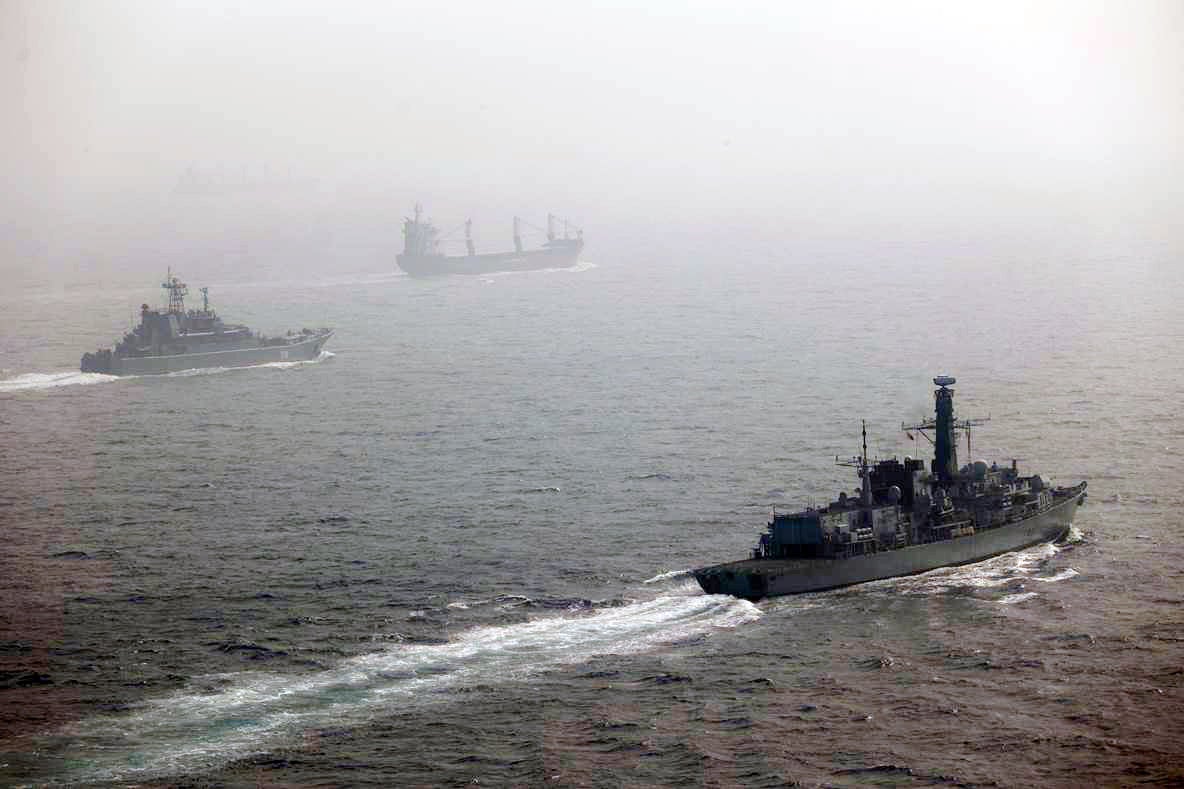
“Patrol ships HMS Tyne, Ledbury, Severn, Mersey and Type 23 frigate HMS Sutherland tracked the Russian navy’s Admiral Grigorovich throughout May and into June.
“This followed a concerted effort in April, when Royal Navy ships or aircraft monitored the Russian warship every single day.”
42 Commando of the UK Commando force conducting maritime interdiction operations on CMR Smyrtos sailing under a false Cameroonian flag (PA)
The yacht incident came two days after Russian shadow fleet tanker MV Smyrtos was seized on 14 June.
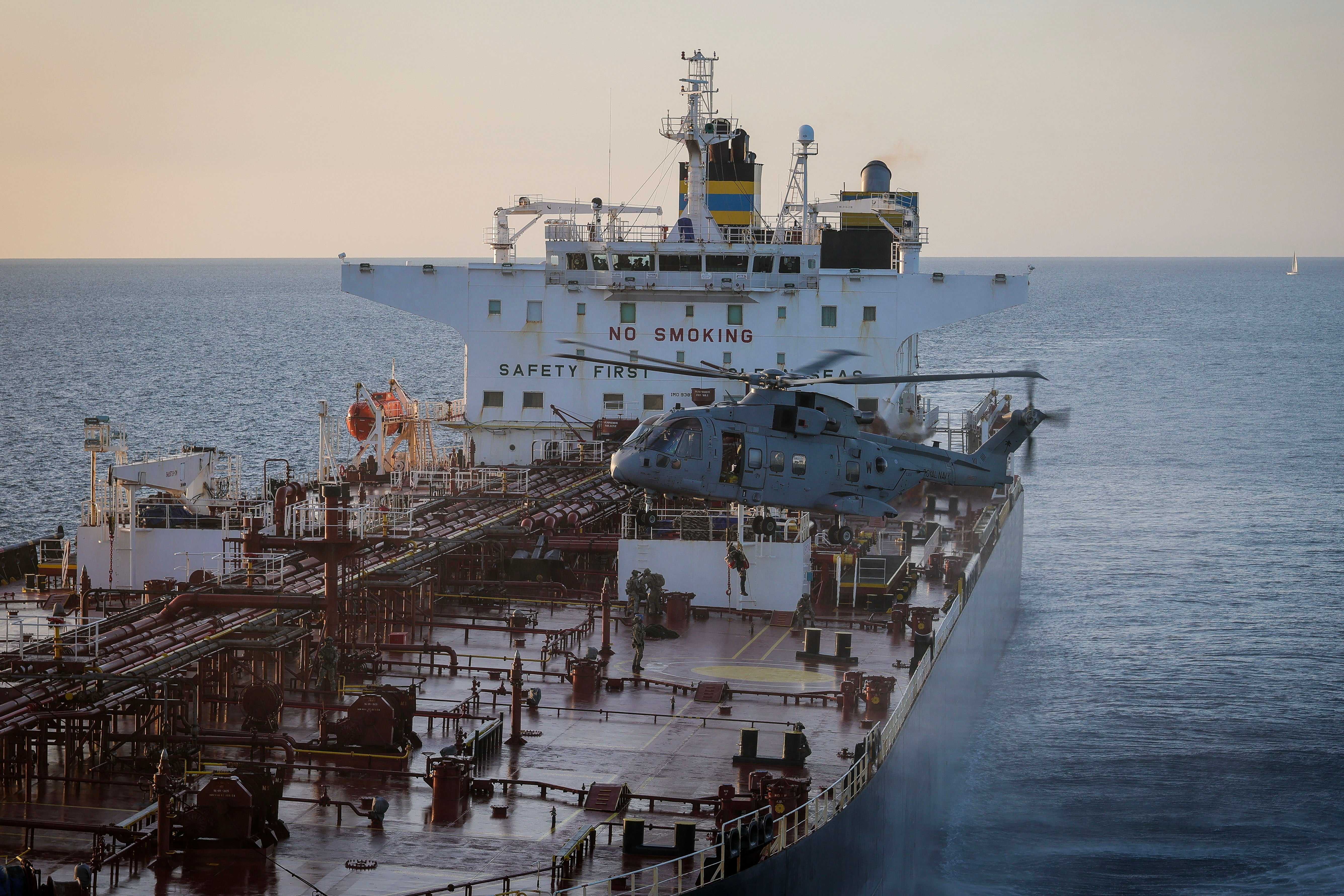
The Navy spokesman said: “Green berets from 42 Commando, alongside specially-trained law enforcement officers from the National Crime Agency, boarded the vessel Smyrtos in a six-hour mission supported by HMS Sutherland, HMS Ledbury, Merlin Mk4s from the Commando Helicopter Force, Wildcat helicopters, and RAF Chinooks and P8 Poseidon aircraft.”
Minister for the armed forces Louise Sandher-Jones said: “The Royal Navy is on watch every hour of every day, protecting our waters and helping to keep the UK secure.
“As Russian naval activity around the UK continues, our sailors and aircrew have worked alongside Nato allies and Ireland to track, monitor and deter vessels operating near our shores.
“I pay tribute to the men and women who carry out this vital work every day. Their professionalism sends a clear message: we are always on watch, and we will always defend our nation, our waters and our critical infrastructure.”
Royal Navy Fleet Commander, Vice Admiral Steve Moorhouse, said: “In recent months, the Royal Navy has worked tirelessly to safeguard UK waters in response to increased Russian naval activity.
“Our sailors, ships and aircraft have maintained a constant watch, helping to protect the UK’s security and reassure our allies.
“Their professionalism, dedication and teamwork demonstrate the Royal Navy’s ability to respond quickly to emerging challenges with Nato partners to keep our seas safe and secure.”
Defence of HMS Somerset escorting Russian Navy Ropucha-class Landing Ship Transport Aleksander Shabalin (left) and the tanker MV Mikhail Britnev through the English Channel on Monday (PA)
The Navy spokesman said the monitoring operation also included HMS Tyne observing the Grigorovich “conduct a raft-up with Russian Amur-class supply ship PM-82 near the Galloper Wind Farm off the coast of Suffolk”.
He said: “The supply ship operates as a floating workshop capable of transferring fuel and stores to Russian warships.”
He added that Type 23 frigate HMS Somerset intercepted the Yury Ivanov, a Russian navy intelligence-gathering ship.
The spokesman said: “The operation was conducted alongside other Nato warships and supported by maritime patrol aircraft and vessels from the Irish Defence Forces, ensuring continuous monitoring of the vessel’s movements.”
He added: “Somerset was subsequently tasked to sail from the Isles of Scilly to shadow the Ropucha-class Landing Ship Transport Aleksander Shabalin and the tanker MV Mikhail Britnev through the English Channel – the latest chapter in a sustained maritime surveillance mission.”
Sat 27 Jun 2026 12.00 BST
Forget crumbling democracy: America’s biggest crisis is a stagnant, murky pool.
The Lincoln Memorial reflecting pool is a painful metaphor for the state of our union.
When you hear the word “pool” in these sun-baked days of summer, you might think of taking a cheeky dip in the water to cool off the skin that is conspicuously peeling off your haggard body. Everyone (except me) loves a pool. Donald Trump really loves a pool, but not the kind you can swim in. Or stand too close to. Or enjoy at all, really.
The state of the Lincoln Memorial reflecting pool rehabilitation effort has become the primary crisis affecting the United States. That is, if you ask the current administration. Limiting the right to vote is running a close second in the World Cup of Political Football, but it’s the reflecting pool that is attracting the most fervent attention. As emergencies go, it’s as thrilling as watching a really large body of still water in the middle of a park. The paint is peeling and it’s full of green algae.
While the inability to keep the pool from looking like a stagnant lake in the Ozarks carries some pretty serious environmental omens about the perilousness of our global water supply, the site itself is not exactly a massive national emergency. I’m more concerned with my Apple Watch beeping about my heart rate after a third martini than I am an artificial lake that … shows you a reversed version of the thing you’re standing in front of. Yup, there it is. That building. Again. But upside down. Brilliant.
The reflecting pool is just another pointless infrastructure project in a long line of pointless infrastructure projects that have come to define the blockbuster sequel to Trump 1.0. The White House ballroom, the Kennedy Center, the comically large arch designed to give Europe serious concrete envy. The politics pages of the news are starting to look more like Architectural Digest, which, quite frankly, is more fun to read usually. Except: every single one of these projects seems doomed to failure. The projects barely limp along as more than the governmental equivalent of a grandpa’s bucket list. Trump’s name is off the Kennedy Center. The ballroom is mired in litigation and political wrangling. The reflecting pool is a mess. It’s a parade of no-bid contracts, outlandish promises and unchecked vanity. Naturally, all these problems have to be someone else’s fault.
According to Trump, the reason the reflecting pool looks like a runny plate of mushy peas full of dead ducks is because vandals cut into the hard surface at the bottom of the pool under cover of darkness. Several people were said to have been arrested for the alleged act, though the details are thin. .
I don’t know if it “reflects” (sorry, I had to) well on the work of Atlantic Industrial Coatings if you can cut large gashes into the pool with some kind of small tool. Or maybe it was actually something more substantial, like a machete or the sword from Final Fantasy VII. I’m sure a pack of people wandering a national monument with massive blades in the middle of the night would avoid detection. Stealth is, of course, one of the primary attributes of the leftist agenda. It should also be said that Trump alleged the vandals dumped fertilizer into the pool, so add that to the midnight packing list. Might as well hire a 20-mule team to lug all that gear.
In response to the ongoing threat of possibly imaginary liberal ninja warriors carrying bags of manure, the government has erected a fence around the pool to keep out agitators, though the administration states that fencing was always meant to go up prior to Fourth of July festivities. It’s just apparently going up sooner to keep the pool secure. Nothing screams “beautification project” quite like a big fence. The Louvre should put up some chain-link around their artworks while we’re at it.
National monuments and historical landmarks are usually created for the sake of the public’s enjoyment. I might not personally see much use in staring at my own reflection, but I can see the appeal for some. Specifically Trump, who probably can’t help but take a gander at his own face staring back at him. It might be a dream he’s had more than once. There I am. Look at me. I’m so me, it’s outrageous how very me I can be. Perhaps we should just replace the pool with a large bit of mirrored glass. Pretty much the same thing, but with less bacteria fermenting. Just don’t stand too close to it at midday.
Sometimes, it feels like America is a Star Trek-style mirror universe where everything is backwards, nothing quite looks correct and everyone is sporting a goatee (metaphorically speaking). I think I’ve gotten to the point where everything not making sense has come around to making total sense. The paradox of delaying an affordable housing bill to prioritize a restrictive voting bill no one wants. The aching metaphors of the stagnant, murky pool meant to memorialize democratic progress. Is this a perverted alternate dimension reflecting back at us or just another day in soul-crushing reality?
Цитата:
Australia to double penalty for social media ban breaches to $99m as tech giants accused of ‘not doing enough’.
Prime minister Anthony Albanese says too many children still on platforms but he is ‘heartened’ by world-leading law.
The federal government will double the penalty for breaches of Australia’s youth social media ban to $99m, arguing tech companies are “not doing enough” to keep children off harmful social media sites.
And the eSafety commissioner, now investigating potential breaches of the law by Facebook, Instagram, Snapchat, TikTok and YouTube, will have its information-gathering powers strengthened under proposed further reforms.
“I’m heartened by the shift in conversation and the global momentum we’ve seen since introducing the social media minimum age,” the prime minister, Anthony Albanese, said, “but it’s clear big tech are not doing enough to comply with the law – there are still too many children on social media.”
The government said more than 5m accounts held by under-16s had been removed, deactivated or restricted since Australia’s world-leading ban was introduced on 10 December, but research suggested the majority of under-16s were bypassing age restrictions and still accessing social media.
The proposed new laws would double the penalty for systematic breaches of the under-16s social media ban – from $49.5m to $99m – bringing it into line with penalties available under competition and consumer law.
The reforms would also give the eSafety commissioner the power to compel social media companies to provide evidence of what they have done to stop under-16s from opening or using an account. The commissioner would be able to demand information and documents, including from third parties, such as age assurance or app store providers.
“Australia is leading the world in our efforts to keep kids and young people safe online,” Albanese said.
“These changes reflect the seriousness with which we take any failure by social media companies to comply with our world-leading law.”
Since Australia became the first country in the world to legislate a social media-ban for under-16s, international momentum for similar reforms has been growing.
The French national assembly had passed legislation to prohibit access to social media accounts for children under 15 – with provisions for parental consent – and the UK government had announced plans for an “Australia-plus” ban for under-16s from 2027, with additional restrictions.
Similar proposals were also being considered by Slovenia, Poland, Spain, Denmark and Malaysia.
But research evaluating the effectiveness of Australia’s ban found more than 80% of under-16s were still using social media, three months after the legislation came into force.
A study of more than 400 12- to 17-year-olds by the University of Newcastle concluded Australia’s social media minimum age legislation had resulted in “limited implementation, incomplete compliance, and substantial circumvention of social media restrictions”.
“Overall, we found insufficient evidence to conclude that exposure to the act [of parliament] had any early substantial effects on social media use among adolescents aged under 16 years,” the authors said.
The research, published in the BMJ this month, found that while two-thirds of teenagers in the study reported being asked to complete age verification checks, only 5% of 12- to 13-year-olds and 11% of 14- to 15-year-olds had to provide a photo of official ID. The two most common checks were asking teens their age or uploading a picture of themselves.
A significant minority of participants said they actively bypassed the age restrictions. About 15% of the 12- to 13-year-olds and 19% of the 14- to 15-year-olds surveyed said they used a fake account, while about 3% said they used a VPN.
The study argued the Australian social media ban may be more effective in preventing or delaying access to social media in children under eight, rather than restricting access to adolescents who already use it.
The communications minister, Anika Wells, said that after six months of operation of the social media law, she did not believe big tech companies were doing everything they could to exclude under-16s.
“Based on the regular updates I receive from the eSafety commissioner, it is clear to me that social media platforms are adopting tricks straight out of the big tech playbook and doing the bare minimum to get by.
“In response, I am making sure the regulator has stronger tools to get the job done and doubling the fines for non-compliance.”
She said social media platforms were some of the richest and most powerful companies in the world, but the government would not be deterred from ensuring the children’s social media ban was upheld.
“These tough new penalties and powers show we will not back down. Instead, we are doubling down on our efforts to hold big tech to account.”
_________________
С сожалением и понятными пожеланиями, Dimitriy.
Уровень доступа: Вы не можете начинать темы, Вы не можете отвечать на сообщения, Вы не можете редактировать свои сообщения, Вы не можете удалять свои сообщения, Вы не можете голосовать в опросах
Марианна Базаркулова, эксперт по практическому применению ИИ в бизнесе платформы искусственного интеллекта LibraChat, на примере текстов рассказала, по каким признакам можно распознать нейросетевой контент.
В креативных индустриях рынок труда давно стал навыкоцентричным. Работодатель внимательно смотрит на реальные компетенции, тщательно тестирует практические умения. При этом, диплом, статус вуза и ранее занимаемые должности значат для работодателя всё меньше. Конечно, в таких условиях найм становится более трудоёмким и кропотливым, что не позволяет диджитал-агентствам масштабироваться в нужном темпе.
Спасением становятся стажировки. Агентство «Лайка» второй год проводит стажёрские программы для студентов и молодых специалистов. По их результатам ребята не только осваивают практические навыки на реальных проектах, но и трудоустраиваются. Классический «вин-вин», как, если бы это была не стажировка, а бизнес-сделка.
В 2025 году вектор развития рекламной индустрии изменился: период восстановления сменился этапом оптимизации затрат и повышения окупаемости инвестиций. На фоне инфляции и макроэкономических факторов динамика рынка снизилась, а рекламодатели перераспределили бюджеты в пользу экосистем и инструментов с измеримым возвратом средств. Вадим Мельников, директор Kokoc Performance (входит в Kokoc Group), проанализировал показатели прошедшего года и рассмотрел сценарии развития рынка на 2026 год.
Владимир Нерюев, заместитель генерального директора коммуникационного агентства "Аура" (в составе "Газпром-Медиа Холдинг"). По мнению современных демографов, поколение Z – это молодые люди, которые родились после 2003 года. То есть сегодня им не более 22-23 лет. Они буквально только что закончили обучение в университетах и прямо сейчас выходят на рынок труда. Но насколько готово современное общество, состоящее из представителей других поколений, принять их ценности и их подход к работе?
Александр Комаров, заместитель генерального директора рекламного агентства Аура в составе Газпром-Медиа Холдинга рассказал о трендах классических медиа. В бешеном ритме цифровой трансформации, когда все говорят об алгоритмах, таргетинге и инфлюенсерах, легко списать классические медиа — телевидение, радио, прессу и наружную рекламу — в архив. Но тот, кто из года в год наблюдает и видит все изменения, связанные с рынком рекламы в последнее время можно предположить: именно в 2024-2025 годах мы наблюдаем не упадок, а качественный ренессанс «традиционных» каналов. Их роль кардинально меняется, и грамотные игроки уже используют этот тренд.
Advertology побывал на выступлении бизнес-психолога Евгении Хижняк на конференции SM Network 2025 и рассказывает, как оставаться успешным в мире постоянных перемен.
Чего не хватает радио, чтобы увеличить свою долю на рекламном рынке? Аудиопиратство: угроза или возможности для отрасли? Каковы первые результаты общероссийской кампании по продвижению индустриального радиоплеера? Эти и другие вопросы были рассмотрены на конференции «Радио в глобальной медиаконкуренции», спикерами и участниками которой стали эксперты ГПМ Радио.
Деловая программа 28-й международной специализированной выставки технологий и услуг для производителей и заказчиков рекламы «Реклама-2021» открылась десятым юбилейным форумом «Матрица рекламы». Его организовали КВК «Империя» и «Экспоцентр».
28 марта в Центральном доме художника состоялась 25-ая выставка маркетинговых коммуникаций «Дизайн и реклама NEXT». Одним из самых ярких её событий стал День социальной рекламы, который организовала Ассоциация директоров по коммуникациям и корпоративным медиа России (АКМР) совместно с АНО «Лаборатория социальной рекламы» и оргкомитетом LIME.









 RSS
RSS