Soulless summer fairs and cute puppies: AI poster slop is taking over a pub near you.
A vapid style of graphic is infiltrating social media groups and being used to advertise local events across the country – though no one seems to actually like it. Katie Rosseinsky takes a closer look at why those using prompt-painting will end up regretting it.
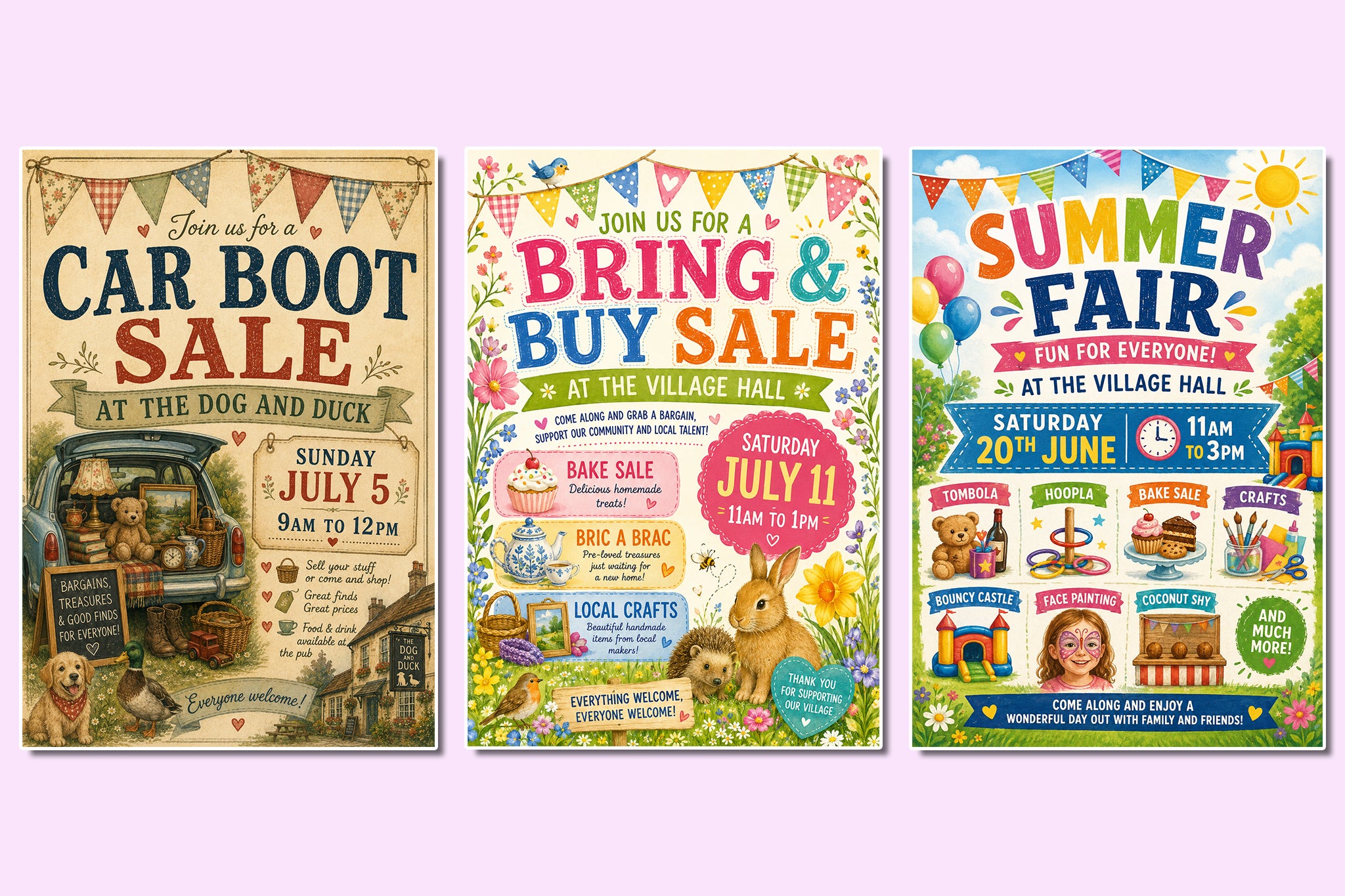
AI flyers, like these ChatGPT-generated examples, are visible everywhere you look – shop windows and Facebook groups alike (ChatGPT)
There is a scourge taking over Britain’s towns. Glance at the notices pinned to the wall in the pub or scroll through a local Facebook group and you’ll be met with a barrage of event posters that look uncannily alike.
Whether they’re advertising a summer fair at the community centre, a car boot sale at the park or an open mic night in the beer garden, these flyers share similar fonts, interchangeable layouts, and an overwhelming air of soullessness. Another thing that they have in common? They were generated by AI.
Once you’ve started to notice the hallmarks of this aesthetic – if derivative slop coughed out in a few seconds by a large language model (LLM) can really be said to possess anything as lofty as an aesthetic – you’ll start to see them everywhere. It’s a look that has the nation’s bulletin boards in a chokehold of anonymous cutesiness.
How to describe it? The overall feel is busy and often fussy, the backdrops crammed with flowers, smiling kids playing, or cute animals (there’s always the possibility that ChatGPT will have bestowed a puppy with an extra paw, or elevated the ducks to gargantuan proportions, given AI’s continued but less obvious propensity for haunting visual errors).
A dash of bunting tends to crown the corners of the page, and the fonts are rudimentary, the sort of thing that would send a proper graphic designer into a decline. All the relevant information seems, for some inexplicable reason, to be overlaid on planks of wood, or ye olde scrolls, perhaps to summon up a semblance of rustic charm. There is, of course, nothing remotely rustic about an image that has been cobbled together by a bot powered by massive, water-gobbling data centres.
Plus, the images often have the yellowy-beige undertone that has become a telltale sign of ChatGPT (it’s thought that AI models like OpenAI’s will have learnt from a dataset filled with warm, “golden hour”-style images from social media, so inevitably sway towards yellowness).
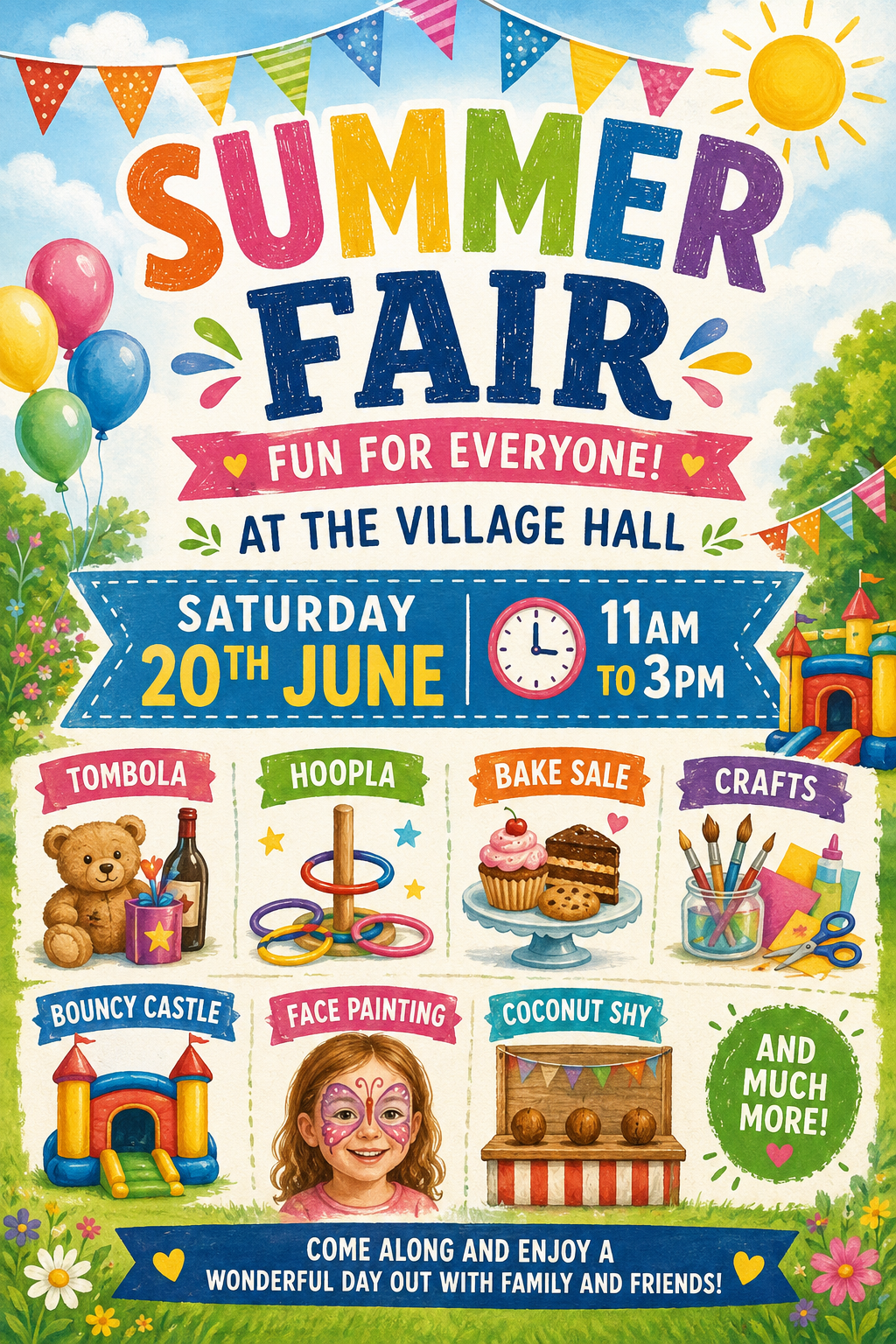
Summer (slop) fair: ChatGPT can create an identikit poster in a matter of moments (Created by ChatGPT)
This plague of drab ads is enough to leave you asking: whatever happened to the noble pursuit of throwing some clip art onto a blank Word document, jazzing up the fonts with a sunset gradient and hoping for the best? At least those efforts had a whiff of human endeavour about them – even if they did tend to rely heavily on Comic Sans.
In the interests of investigative journalism, I asked ChatGPT to create a poster for a generic summer fair at “the village hall”, with a few classic fete activities. It took a matter of seconds for it to come up with a boring but essentially functional image – one that looked just like the other posters I’d already seen.
This style, it seems, has very quickly become ChatGPT’s default – flattening out any quirks and creating a truly tedious universal visual language, from Cornwall to Carlisle.
In April, the artist Barry Whitehouse collated 12 flyers from across the UK to demonstrate just how out of hand this trend has become. “All these posters look the same, yet they are from different areas in the UK, so much so I was concerned that I had repeated the same poster when compiling this,” he wrote in a Facebook post that has been shared 4,000 times.
It is not hard to see how this poster slop has become so ubiquitous. If you’re a volunteer who is tight on time, or working in hospitality during this particularly thankless period for the industry, then the idea of seemingly being able to pluck a passable event graphic out of thin air for free might be an appealing one.
But what about all the designers who are being pushed out of jobs in favour of this sterile anti-creativity? And what about the environmental impact? In 2023, a study from AI startup Hugging Face and Carnegie Mellon University found that making an image using generative AI can use up as much energy as fully charging a smartphone. It’s also a particularly thirsty form of technology – a medium-sized AI data centre will use up to 110 million gallons of water each year to keep its servers cool.
And for all its ubiquity, this style seems beloved by… absolutely no one. When I start canvassing opinions about poster slop, words like “cringe-inducing” and “off-putting” crop up again and again. For writer Lauren Johns, “there’s something I can’t explain about the style that I just can’t connect with at all”, she says, describing it as “overdone” and lacking any personality.
As someone who spends a lot of time supporting and writing about the creative industries, Johns says that she often wonders whether the AI in question has been trained on the work of illustrators, who might not have consented to or even realised that their art was being used as a data set.
But she has also encountered resistance when she has voiced anti-AI views. When she called out someone advertising a creative workshop using an AI-generated poster, they responded by suggesting that making an ad from scratch would cause them to burn out.
The ethical issues surrounding AI are not a mystery, and pretending it is just a tool like any other tells me that the person or people organising the event are either disingenuous or wilfully ignorant
Jayne Cole, photographer.
Reshmi Bennett, founder of bespoke cake company Anges de Sucre, is even more forthright. For her, AI ads are “an instant ick,” and an immediate sign of a lack of care. “As a consumer, I would choose not to attend the event if its poster is screaming AI slop, because it tells me the organisers have put little thought or effort into marketing and I’d assume that’s how they’d approach every other aspect of the event”.
James Bleakley, co-founder of luxury bakehouse Bumble & Goose, says that he initially used AI to generate some graphics for his brand, “but it didn’t take long before they stopped standing out and started blending in with everything else online” – while the results “looked polished at first glance”, they were actually “quite generic and forgettable”.
He also serves as an administrator on a few Facebook groups that keep “getting flooded with scam events with AI images”. Although the flyers might look professional, he explains, “the events don’t exist and [the “organisers”] just want to steal the booking fee from the unsuspecting trader”.
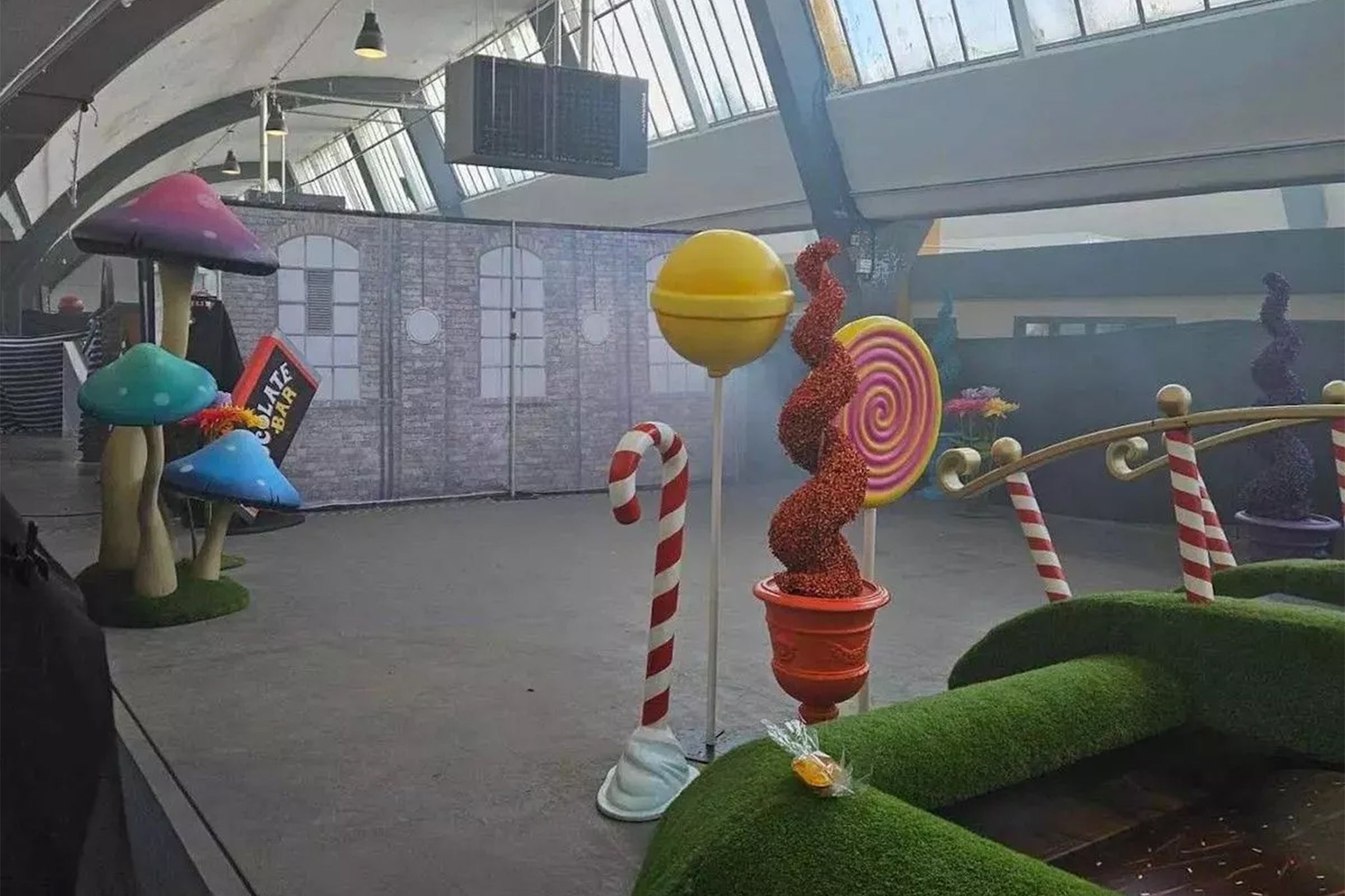
The notorious Willy Wonka experience used AI ads – but the real event failed to live up to the imagery (Stuart Sinclair/Facebook)
Indeed, there is something unavoidably scammy about the AI poster aesthetic, even if the events they’re pushing are entirely legitimate. You only have to recall the chaos of the notorious Willy Wonka experience as a cautionary tale.
Back in 2024, unsuspecting families turned up at a warehouse in Glasgow off the back of colourful AI-generated advertisements, expecting a world of pure imagination brought to life. When they arrived, they were greeted by a few lacklustre candy cane decorations and some put-upon drama students in green Oompa Loompa wigs.
What’s particularly ironic is that this technology is being used to promote events that are ostensibly all about bringing local people together. But for many of us, AI feels fundamentally at odds with that mission.
Photographer Jaye Cole is active in various community groups and clubs but, she tells me, “absolutely refuse[s] to have anything to do with events that are advertised using AI images or text”, because of this disconnect. “The ethical issues surrounding AI are not a mystery, and pretending it is just a tool like any other tells me that the person or people organising the event are either disingenuous or wilfully ignorant – two traits I don’t think are compatible with community,” she says.
She would much rather, she adds, “deal with real people and real art, even if it’s bad”. I couldn’t agree more – a Comic Sans comeback has never seemed so appealing.
…
_________________
С уважением и очевидными отраслевыми пожеланиями, Dimitriy.
Уровень доступа: Вы не можете начинать темы, Вы не можете отвечать на сообщения, Вы не можете редактировать свои сообщения, Вы не можете удалять свои сообщения, Вы не можете голосовать в опросах
В креативных индустриях рынок труда давно стал навыкоцентричным. Работодатель внимательно смотрит на реальные компетенции, тщательно тестирует практические умения. При этом, диплом, статус вуза и ранее занимаемые должности значат для работодателя всё меньше. Конечно, в таких условиях найм становится более трудоёмким и кропотливым, что не позволяет диджитал-агентствам масштабироваться в нужном темпе.
Спасением становятся стажировки. Агентство «Лайка» второй год проводит стажёрские программы для студентов и молодых специалистов. По их результатам ребята не только осваивают практические навыки на реальных проектах, но и трудоустраиваются. Классический «вин-вин», как, если бы это была не стажировка, а бизнес-сделка.
В 2025 году вектор развития рекламной индустрии изменился: период восстановления сменился этапом оптимизации затрат и повышения окупаемости инвестиций. На фоне инфляции и макроэкономических факторов динамика рынка снизилась, а рекламодатели перераспределили бюджеты в пользу экосистем и инструментов с измеримым возвратом средств. Вадим Мельников, директор Kokoc Performance (входит в Kokoc Group), проанализировал показатели прошедшего года и рассмотрел сценарии развития рынка на 2026 год.
Владимир Нерюев, заместитель генерального директора коммуникационного агентства "Аура" (в составе "Газпром-Медиа Холдинг"). По мнению современных демографов, поколение Z – это молодые люди, которые родились после 2003 года. То есть сегодня им не более 22-23 лет. Они буквально только что закончили обучение в университетах и прямо сейчас выходят на рынок труда. Но насколько готово современное общество, состоящее из представителей других поколений, принять их ценности и их подход к работе?
Александр Комаров, заместитель генерального директора рекламного агентства Аура в составе Газпром-Медиа Холдинга рассказал о трендах классических медиа. В бешеном ритме цифровой трансформации, когда все говорят об алгоритмах, таргетинге и инфлюенсерах, легко списать классические медиа — телевидение, радио, прессу и наружную рекламу — в архив. Но тот, кто из года в год наблюдает и видит все изменения, связанные с рынком рекламы в последнее время можно предположить: именно в 2024-2025 годах мы наблюдаем не упадок, а качественный ренессанс «традиционных» каналов. Их роль кардинально меняется, и грамотные игроки уже используют этот тренд.
Дмитрий Шиманов, основатель и генеральный директор аналитической компании MAR CONSULT, по данным отчета Euromonitor International "Top Global Consumer Trends 2026" спрогнозировал, как будут меняться потребительские ожидания и поведение в течение текущего года под влиянием глобальных трендов и на фоне локальных экономических вызовов.
В контексте глобальной фрагментации рынков и геополитических рисков российские потребители все больше будут ориентироваться на локальные альтернативы импортным товарам, с акцентом на ценовую доступность и практичность.
Advertology побывал на выступлении бизнес-психолога Евгении Хижняк на конференции SM Network 2025 и рассказывает, как оставаться успешным в мире постоянных перемен.
Чего не хватает радио, чтобы увеличить свою долю на рекламном рынке? Аудиопиратство: угроза или возможности для отрасли? Каковы первые результаты общероссийской кампании по продвижению индустриального радиоплеера? Эти и другие вопросы были рассмотрены на конференции «Радио в глобальной медиаконкуренции», спикерами и участниками которой стали эксперты ГПМ Радио.
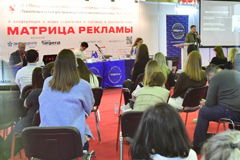
Деловая программа 28-й международной специализированной выставки технологий и услуг для производителей и заказчиков рекламы «Реклама-2021» открылась десятым юбилейным форумом «Матрица рекламы». Его организовали КВК «Империя» и «Экспоцентр».
28 марта в Центральном доме художника состоялась 25-ая выставка маркетинговых коммуникаций «Дизайн и реклама NEXT». Одним из самых ярких её событий стал День социальной рекламы, который организовала Ассоциация директоров по коммуникациям и корпоративным медиа России (АКМР) совместно с АНО «Лаборатория социальной рекламы» и оргкомитетом LIME.






 RSS
RSS