Russia owes Western banks $120 billion. They won't get it back
...
London (CNN Business)Goldman Sachs is the first major Western bank to get out of Russia following the invasion of Ukraine. More are likely to follow at a cost of tens of billions of dollars.
The Wall Street giant said Thursday that it is "winding down its business in Russia in compliance with regulatory and licensing requirements," a Goldman Sachs spokesperson said.
The departure follows a scramble by Western banks to tally their exposure to Russia after President Vladimir Putin ordered the invasion of Ukraine, triggering punishing sanctions that cover most of the country's financial system, including its central bank and top commercial lenders — VTB and Sberbank.
It also comes after a stampede of Western businesses out of just about every other sector of Russia's economy, and as ratings agencies warn that a Russian debt default is imminent.
International banks are owed more than $121 billion by Russian entities, according to the Bank for International Settlements, which suspended Russia's membership on Thursday. European banks have over $84 billion total claims, with France, Italy and Austria the most exposed, and US banks owed $14.7 billion.
Goldman Sachs (GS) earlier disclosed that it had credit exposure to Russia of $650 million in December 2021.
Other banks with more to lose could soon follow Goldman Sachs out of Russia. Kremlin spokesperson Dmitry Peskov said Thursday that the economic situation in Russia is "absolutely unprecedented" and blamed the West for an "economic war." Moscow has pledged to retaliate for the sanctions, and some banks have suggested that their assets could be seized or nationalized by the Kremlin.
Fitch Ratings warned previously that "large western European banks' asset quality will be pressured by the fallout from Russia's invasion of Ukraine," and that their operations also face increased risk as they race to comply with international sanctions.
French bank Societe Generale (SCGLF) said last week it is "rigorously complying with all applicable laws and regulations and is diligently implementing the measures necessary to strictly enforce international sanctions as soon as they are made public."
The bank said it had almost $21 billion in exposure to Russia at the end of last year.
Societe Generale "has more than enough buffer to absorb the consequences of a potential extreme scenario, in which the group would be stripped of property rights to its banking assets in Russia," it said.
France's BNP Paribas (BNPQF) said on Wednesday that its exposure to both Russia and Ukraine totals €3 billion ($3.3 billion).
Italy's UniCredit (UNCFF), which has been operating in Russia since 1989, said last week that its Russian arm was "very liquid and self-funded," and that the franchise accounts for just 3% of the bank's revenue. On Tuesday, it said that its exposure to Russia totals roughly €7.4 billion ($8.1 billion).
Credit Suisse (CS) said Thursday that it has exposure to Russia of 1 billion Swiss francs ($1.1 billion).
Deutsche Bank (DB) said in a statement on Wednesday that it has "limited" exposure to Russia, with gross loan exposure of €1.4 billion ($1.5 billion). The German lender said it has significantly reduced its exposure to Russia since 2014, with further action taken over the past two weeks.
US banks could feel pain, too. Citigroup (C) disclosed last week that it had roughly $10 billion in total exposure to Russia.
Mark Mason, the bank's chief financial officer, told investors that the bank has been performing tests to evaluate the consequences "under different stress type of scenarios." He said the bank could lose roughly half its exposure in a "severe" scenario.
Citi said Wednesday that it would stick to its plan of exiting its consumer banking business — but it might be very hard to find a buyer given the political and economic climate.
"As we work toward that exit, we are operating that business on a more limited basis given current circumstances and obligations," it said in a statement. "With the Russian economy in the process of being disconnected from the global financial system as a consequence of the invasion, we continue to assess our operations in the country," it added.
The European Central Bank addressed the risk to the banking sector on Thursday, saying that Europe's financial system has enough liquidity and there were limited signs of stress.
"Russia is important in terms of energy markets, in terms of commodity prices, but in terms of the exposure of the financial sector, of the European financial sector, Russia is not very relevant." said Luis de Guindos, vice president of the central bank.
"The strains and the tensions that we have seen are not comparable at all to what happened at the beginning of the pandemic," he added.
Цитата:
Opinion | Why Putin Can’t Win the Propaganda War at Home
...
ladimir Putin slipped a noose around the throat of independent Russian media last week, and with a few tugs has begun to choke the life from it.
Drawing on his existing legal powers and new ones passed by the Russian legislature — which forbids the spread of information that contradicts the official Russian take on the Ukraine war, punishable by 15 years in prison — Putin has silenced domestic critics of his regime. In reaction to the new measures, opposition radio station Ekho Moskvy and TV Dozhd (Rain) have closed shop. Mediazona, which covers political arrests, Snob magazine, the Agentstvo investigative news site and others have been blocked by the government. Access to Facebook and Twitter has been interrupted, and Russians can no longer upload to Tik Tok. Many international news organizations have either abandoned their Russia bureaus or curtailed their reporting.
The clampdown has relegated the war to news outlets that agree to call the Ukraine invasion a “special military operation,” that proclaim as “fake” the bombed-city footage we’ve been watching, and that assert that Russian troops are “rescuing” Russian-speaking people from “Nazis.” Official Russian propaganda has now obliterated what was — by Soviet standards, at least — a relatively free media environment. That doesn’t mean Putin has been a free speech radical during his time in office. The New Yorker noted his general hostility to open expression last summer and his regime’s attacks on journalists are well-documented.
But information technology has gained a significant toehold in Russia, making it difficult for the state to blot out the messages it disdains, and the country’s younger citizens have been exposed to too many Western experiences through travel and media to ever swallow whole government propaganda again. Whether he knows it or not, Putin seems doomed to lose an extended propaganda war at home.
Putin mistakenly thinks it’s 1955 and that media suppression can douse inconvenient information. While he can propagandize from the Kremlin, promising that only he can make Russia safe from an encroaching NATO and the decadent West, he is not the only authority. For almost three decades now, curious Russian people have consumed the international press and learned how manipulative official media can be. Many have traveled to the West, too, and attended college abroad, which has given them the critical perspective that might have been denied to their parents. The internet has provided a window on the world through which Russians can judge their own country. Russia hasn’t become a Western country by any means, but compared to the time before the fall of the wall, it’s become increasingly globalized, both economically and culturally. Putin may be able to pause that integration, but can he reverse it? Doubtful.
So far, Putin has sold the Ukraine war to Russian citizens through state propaganda and official pronouncements. But how well can his pitch — I’m waging war to protect Russian-speaking people in Ukraine and bombing only military targets — work on Russian citizens who have family and friends in Ukraine? They might believe Putin in the short term, but how will they react when their Ukrainian familiars phone them the truth? For them, it will land as solidly as the idea that the United States had cause to launch an invasion of Quebec because English-speakers need protection from rampaging Quebecois. It’s easier to stop scuttlebutt spread by media than it is scuttlebutt spread by family and friends.
Even though Putin now controls Russian media, he can’t prevent inquiring Russians from using VPN accounts to breach the official blockade of news and social media on the internet. According to one source, demand for VPNs in Russia has risen dramatically since the media clampdown, as have downloads of Telegram and Signal, two encrypted messaging apps. A Russian with a computer and an internet connection can be as well informed about the war as any Westerner if they ignore Putin’s don’t-look-up order. This could change, of course. The man who would bomb a children’s hospital is capable of anything. Putin possesses police-state powers that he could deploy. He could kerosene the Russian internet and set it aflame. He could jam the BBC’s revived shortwave service into Russia. He could try to ban VPNs, but not even China has done that. He could upgrade the monitoring of internet traffic. Or he could expand the “spot checks” of protesters’ smartphones, a tactic used at anti-war rallies in Moscow, in his search for dissidents. He could even hunt down and incarcerate Russians who voice their opposition to the war, sotto voce, in the comments sections of restaurant websites.
Putin might think he can rehang the iron curtain to prevent anything Western from landing in Russia. The propagandists will always have the edge with people who deliberately avoid exposure to accurate news. But technology, geography and recent history will hinder such a resurrection. The most honest witnesses to war, as America learned with Vietnam, are veterans. Is Putin prepared to cut off the tongues of the conscripts he fed to the Ukraine war when they come home to tell their story? Putin might win a few propaganda skirmishes with his people, but he won’t win the war.
Russian energy sanctions unite the feuding parties — for now
...
The invasion of Ukraine has managed to unite Republicans and Democrats on an energy policy for the first time in years — but don’t expect it to last.
The House passed last night a bipartisan bill to prohibit shipments of Russian fossil fuels to the U.S. in a bid to squeeze the commodities that provide a crucial economic lifeline for Vladimir Putin’s regime. Each party, though, hopes the blocking of oil and petroleum imports will benefit their larger priorities — with Republicans continuing to push for more domestic drilling while Democrats champion action on climate change.
“We draw completely opposite conclusions,” said Rep. Dan Crenshaw (R-Texas).
The humanitarian crisis in Ukraine remains the main driver behind the legislation, which comes after President Joe Biden on Tuesday announced an executive action banning Russian energy imports. The House bill is largely a messaging exercise because the Senate is not expected to take it up and oil traders are already shunning Russian cargoes for fear of being caught up in financial sanctions.
The partnership of convenience has its limits, though.
Republicans bash the Biden administration for policies that they say inhibit domestic oil production, citing the spike in oil prices to $130 a barrel that has driven U.S. gasoline to its highest price ever, $4.25 a gallon as of Wednesday. They’re also calling on Biden to restart the leasing of federal lands to oil and gas drillers, which Biden halted early last year, and approve the Keystone XL pipeline, which would carry Canadian crude oil to refineries in Texas. Energy experts say neither of those policies would have an immediate impact on prices.
The GOP is also urging Democrats to abandon their efforts to fight climate change through huge investments in clean energy technologies like wind, solar, electric vehicles and battery storage.
“The No. 1 way to reduce [carbon] emissions right now would be to massively increase exports of natural gas to displace coal around the world,” Crenshaw said.
Democrats, meanwhile, are redoubling their own strategy, arguing that the best way to prevent petro-states such as Russia from menacing other nations or driving up U.S. gasoline prices is to reduce the nation’s dependency on fossil fuels. And that means supercharging spending on clean energy technologies, they argue.
“Is there any scenario where Republicans don’t think the answer is to extract more fossil fuels?” asked Rep. Sean Casten (D-Ill.).
Casten added: “If we keep doubling down on making our economy more fossil fuel intensive, do we want to be exposed to those global markets? If you care about the American people, if you care about the climate, the medium-term investment has to be in energy efficiency, renewables, and electric vehicles and decoupling that link. Everything else is lies and bullshit.”
Energy experts and Democrats say consumer pain at the pump could hasten the shift away from oil in the U.S. and toward electric vehicles. While electric vehicles make up only about 2 percent of U.S. car sales, and many are prohibitively expensive for many consumers, Democrats have sought to increase the subsidies to buy them while funding better battery technologies that can drive down their cost and enhance their appeal.
Still, the energy crisis caused by Putin’s war in Ukraine has forced even liberal Democrats to recalibrate their views somewhat. Many are supporting Biden’s call for U.S. oil companies to increase their production to fill the gap created by the embargo of Russian imports — even though that production will drive up greenhouse gases.
Energy Secretary Jennifer Granholm joined that theme at an energy industry conference Wednesday in Houston, where she urged oil industry executives to hike their production.
“We are on war footing,” Granholm said. “That means [crude oil] releases from the strategic reserves all around the world. And that means you producing more right now if and when you can. I hope your investors are saying this to you as well. In this moment of crisis, we need more supply.”
Democrats argue there is no tension between saying the U.S. needs more oil production now to help Ukraine win a war against Russia and moving to remove carbon from the country’s energy system as soon as possible.
“Yes, short term we need an increase in oil production, but long term we need a moonshot on renewable energy,” said Rep. Ro Khanna (D-Calif.). “It seems so obvious.”
After years of minimizing the threat from climate change, Republicans have recently come around to acknowledge the problem and to support government funding of some technologies that can help companies reduce emissions, such as carbon capture and nuclear power.
That doesn’t mean, though, that GOP lawmakers will pass up blaming the Biden administration’s clean energy agenda for inflation and high energy prices in an election year.
“Let’s be very clear that they [Democrats] have caused price spikes and they own that totally,” said Rep. Garret Graves of Louisiana, the top Republican of the House Select Climate Committee. “They are continuing to double and triple down on their stupid polices that have led us to where we are right now.”
To counter such GOP attacks, Democrats are looking to restart party-line negotiations over their stalled social and climate agenda by pitching it as a means to fight inflation, maintaining that spending on electric vehicles, boosting energy efficiency and curbing greenhouse gas emissions will yield savings for Americans over time.
Senate Energy Chair Joe Manchin (D-W.Va.), whose opposition helped kill Biden’s Build Back Better bill, recently reopened the door to a smaller reconciliation package that would spend on climate change by providing tax breaks to a bevy of clean energy technologies.
“Let’s get Mr. Manchin to help us pass those EV tax credits,” said Rep. Jared Huffman (D-Calif.). “This Russia discussion should catapult the climate issue right to the top.”
Republicans, meanwhile, are content to watch Democrats restart their green energy efforts. They contend that Americans are unlikely to welcome potential benefits of clean energy spending while they face the immediate crunch from high prices.
“There is no way flooding the economy with more government money is gonna result in anything other than what we have seen already which is high inflation, high prices, supply chain issues,” said Sen. Shelley Moore Capito, the top Republican on the Environment and Public Works Committee.
At least some members of each party say they hoped the united front against Russian energy imports will produce more than just a fleeting moment of bipartisan patriotism, and will foster lasting cooperation on climate and energy policy.
Rep. Nancy Mace (R-S.C.) this week partnered with Khanna to co-sponsor a bill that would ban Russian oil but also force the government to invest in renewables to replace that energy with carbon-free sources.
“For now, we need to be increasing domestic energy production,” Mace said. “In the meantime, let’s come up with a strategy together over a period of time where we get to greener, cleaner, carbon-neutral energy.”
Sen. Bill Cassidy (R-La.), meanwhile, released an energy and climate plan Wednesday that includes ideas with bipartisan appeal, such as easing permitting hurdles for renewable and nuclear projects, and financing reserves of critical minerals used in EV batteries. His proposal, dubbed “Energy Operation Warp Speed,” also pushes traditional Republican ideas such as expanding offshore oil and gas drilling and expediting exports of natural gas.
“We are trying to get a grand bargain,” Cassidy told reporters. “This is not set up to be some partisan hit piece. To the degree there are reasonable Republicans and reasonable Democrats, we are right there.”
Sen. John Hickenlooper (D-Colo.) suggested that the partisan debate is more complicated than it needs to be.
“We are a ways away from having electric vehicles available to everybody that they can afford,” Hickenlooper said. “In that transition, as we move away from refined crude oil and gasoline and toward electric everything, we have to allocate and help consumers deal with price spikes. Hopefully this will be the beginning of a number of decisions we make that are less partisan.”
Цитата:
Из европейских хранилищ отбирают остатки газа предыдущих лет.
По данным Gas Infrastructure Europe, на 7 марта объем активного газа в подземных хранилищах Европы на 22,1% (на 7,5 млрд куб. м) меньше прошлогоднего уровня.
Отобрано уже 49,5 млрд куб. м газа. Это 105,3% от объема, который компании смогли закачать в летний сезон 2021 года.
Напомним, что сделанные в прошлом году запасы в европейских ПХГ были выбраны до нуля еще в феврале. Теперь отбор идет из остатков газа предыдущих лет. В Европе сезон отбора может продлиться до середины апреля.
Общий остаток газа в ПХГ Европы – 27%. Подземные хранилища Германии опустошены уже на 74,4%, Франции – на 80,3%.
Как мы ранее отмечали, для восполнения запасов газа в европейских хранилищах к следующей зиме потребуется закачать такие значительные объемы газа, которые за один летний сезон никогда ранее не закачивались. Это будет оказывать существенное влияние на цену газа на рынке.
Это очень серьезный вызов, учитывая, в том числе, суточные лимиты объемов закачки, которые ограничены технологическими возможностями хранилищ. Кроме того, общий объем доступного на европейском рынке газа сильно зависит от спроса на растущем азиатском рынке.
McDonald's transformed Russia ... now it's abandoning the country
... New York (CNN Business)When McDonald's opened its doors in Moscow for the first time, it was a big deal.
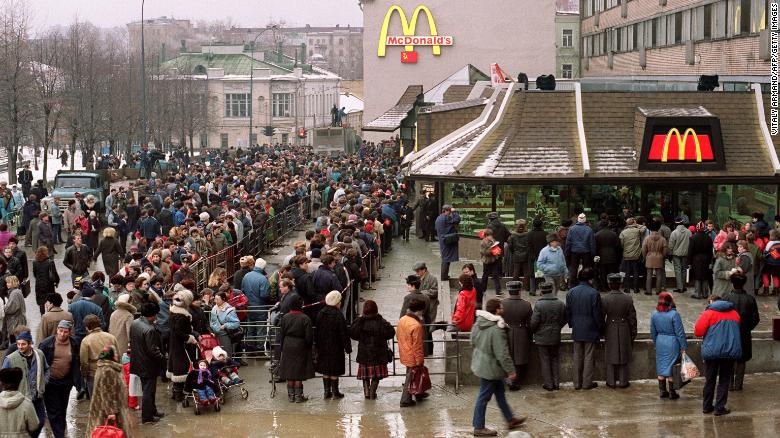
It was the dead of winter — January 31, in 1990 — but still people came out in droves. Grainy CNN television footage shows lines snaking out the door, and throngs of people inside, trying Big Macs for the first time.
The Pushkin Square location was massive, with the capacity to seat hundreds of people. It was the largest McDonald's restaurant in the world at the time. Inside, the fast food joint was bustling. In most ways, it looked like any other McDonald's from the era. But there was a hammer-and-sickle flag under the golden arches and an international theme inside, featuring a model of London's Big Ben in the dining room.
Bright-eyed McDonald's employees wearing maroon branded visors and big smiles took customer orders. They were the chosen ones — about 630 employees made the cut out of 27,000 applicants, according to a 1990 Washington Post article. They underwent a month of training before the store opened for business.
The golden arches were an immediate success. On the first day, 30,000 people were served, a McDonald's record for an opening day, the CBC reported at the time. The location even had to stay open for hours later than planned because of the crowds.
McDonald's arrival in Moscow was about more than just Big Macs and fries, noted Darra Goldstein, Willcox B. and Harriet M. Adsit professor of Russian, emerita, at Williams College. It was the most prominent example of glasnost in action, Soviet Union President Mikhail Gorbechev's attempt to open up his crumbling country to international relations.
"There was a really visible crack in the Iron Curtain," she said. "It was very symbolic about the changes that were taking place." About two years later, the Soviet Union would collapse.
After that first spot opened up, McDonald's expanded its reach within the country. As of last week, there were about 850 locations operating in Russia.
But Russia's invasion of Ukraine prompted McDonald's to change course, at least temporarily. On Tuesday, the company announced that it would pause operations at those restaurants, following similar decisions by other Western firms and pressure from critics.
For Goldstein, this moment is just as symbolic, but far less hopeful.
"If the opening of McDonald's in 1990 symbolized the beginning of a new era in Soviet life, one with greater freedoms, then the company's current exit represents not just a closing down of business, but of society as a whole," she said.
Opening McDonald's up in Russia wasn't easy.
George Cohon, who oversaw McDonald's business in Canada from the early 1970s and into the 1990s, led the campaign to bring McDonald's to life in Moscow. It took 14 years to make that happen.
In his book, To Russia With Fries (with an introduction by none other than Gorbachev) Cohon detailed the difficult process of opening up that first location.
"On the Soviet side, there was very little real understanding of what was involved in establishing or operating a chain of McDonald's restaurants," he wrote. "For our part, we had to identify suitable sites (the Soviets' instincts seemed to be to put us behind the elevator shafts in hotels or somewhere in the outskirts of Moscow; our instincts, naturally, were pretty much the reverse)."
Perhaps more pressing than finding a suitable location was the search for a viable supply chain. McDonald's needed a steady supply of patties and potatoes for the thousands of people who would stream in every day.
"We had to satisfy ourselves that it would be possible to source raw materials in Russia," he said. Cohon and other members of the team visited local food processing plants and found them lacking. McDonald's decided to set up its own.
"In the absence of a reliable infrastructure, we were going to have to build one," Cohon wrote. "We were going to have to go right into the countryside and develop a network of suppliers that didn't exist before."
When McDonald's did finally open its doors in 1990, some were skeptical and believed it wouldn't last.
"It will all go downhill. We don't know how to run a restaurant like this," Andrei Grushin, an engineer who visited the restaurant on opening day, told the Washington Post at the time.
But the pains McDonald's took paid off.
Service with a smile
One of the defining characteristics of the Moscow McDonald's location, at least on that first day, was the friendly staff.
"They are always smiling," a young employee told CNN reporters on opening day. "As you know, in Moscow, not in every restaurant you can find smiling people."
Another employee told the CBC that when she smiled at people, they asked what was wrong. "They think that I'm laughing at them," she said.
At that time in the Soviet Union, "food service was really terrible," said Williams College's Goldstein. "It was rude, places were dirty. There often wasn't food that was listed."
McDonald's was an "almost magical place where food always replenished itself and people smiled at you," she said. "It represented more than just a place to get American hamburgers."
The hamburgers themselves weren't as exciting, at least not to some customers.
"I don't like it at all," one man told the CBC of the food, shaking his head. Another said he liked the cuisine, but had "expected more." The meal was pricey. A meal could cost half a day's pay for the average consumer, according to the CBC.
Olga Berman, who grew up in Moscow before immigrating to the United States in 1993, recalled a trip to McDonald's with her family when she was a child.
"We didn't really go out to eat a ton. So that was a huge experience in itself, to go to restaurants," she said. She remembers McDonald's as "sparkling new," she said. "It was really bright. It was super clean," she added. "It was an experience. it didn't feel like fast food that I know today. It felt like going to an actual restaurant."
And the food? "I don't even remember what the food was like," she said.
Christina Frankopan grew up in London. As a teenager, she went to Moscow for a few weeks to improve her Russian, right around the time of the opening of the first McDonald's location.
In spring 1990, she went with friends to check it out.
"I went once or twice and the queue was just too long," she said. "And, and then eventually, we went one time, and it was doable."
For Frankopan, McDonald's was no big deal. But her friends were excited — less about the food, as she recalled, than about the chain's styrofoam containers. "I was surprised that actually, the packaging was highly coveted," she said.
Frankopan remembers people taking the packaging home and tacking it up on their walls. They said "it's an incredibly good insulating material," she recalled. But "I think, actually, it was a status symbol to be able to show, not only do I have one Big Mac box, I have queued for, you know, 15 times to get my Big Mac boxes."
She added, "I think it's hard to overstate the symbolism of the place."
As CNN reporter Richard Blystone put it, when he reported the story 32 years ago, "a Western hamburger emporium in Moscow has all the intrinsic appeal of an ice cream stand in hell."
After years of investment, everything came crashing down this week.
"In Russia, we employ 62,000 people who have poured their heart and soul into our McDonald's brand to serve their communities. We work with hundreds of local, Russian suppliers and partners who produce the food for our menu and support our brand. And we serve millions of Russian customers each day who count on McDonald's," McDonald's CEO Chris Kempczinski said in a statement on Tuesday.
"In the thirty-plus years that McDonald's has operated in Russia, we've become an essential part of the 850 communities in which we operate," he added.
But the current situation makes continuing in the market untenable, according to the executive, at least for now.
"Our values mean we cannot ignore the needless human suffering unfolding in Ukraine," Kempczinski said. Plus, with the region in upheaval, McDonald's can no longer reliably secure the supply it needs. "We are experiencing disruptions to our supply chain along with other operational impacts," he said.
After 32 years, "McDonald's has decided to temporarily close all our restaurants in Russia and pause all operations in the market."
McDonald's will continue to pay its employees in Russia, the company said.
But it's not clear when Russians will be able to visit a local McDonald's again. "At this juncture, it's impossible to predict when we might be able to reopen our restaurants in Russia," Kempczinski said.
Цитата:
Russian citizens are using emoji codes to avoid authorities and organise protests
...
Russians are using emojis to organize protests in order to avoid censorship.
In February, as Russia invaded Ukraine, a picture of the Russian poet Pushkin accompanied by the number seven and rows of people walking was shared on social media.
The BBC reports that these emojis were a reference that was well-known to authorities, but was still used to spread the word around Russian people to attend demonstrations.
Russians will use phrases like “Let’s go for a walk to the centre” or “The weather is great for a walk” to let others know they will attend a protest, with one describing the evasion of government censors like an inside joke or a meme.
Almost 14,000 people have been detained across Russia since the invasion began, and arrests have reportedly increased since the new law was introduced.
The Russian government is attentive to what people post on social media. One woman reported that, in a court hearing a screenshot of a tweet she had shared about a protest had been taken almost immediately after she had posted it.
Many people in Russia have deleted their social media profiles on sites like Instagram altogether.
The walking emoji is not the only one that has found new connotations from the invasion. The sunflower emoji has been added by users to their social media profiles as a “global symbol of resistance, unity and hope”, the Washington Post reports.
The sunflower (or “soniashnyk”) is Ukraine’s national flower, grown in the country since the middle of the 18th century and cultivated for its seeds. More recently, its use as an emoji stems from a video that went viral of a Ukrainian woman telling Russian soldiers to “take these seeds so sunflowers grow here when you die”.
The symbol has now been worn by US first lady Jill Biden and other senators.
Цитата:
Реклама Агрессии.
_________________
С сожалением и понятными пожеланиями, Dimitriy.
Russia opens criminal investigation of Meta over death calls on Facebook
[img]https://www.reuters.com/resizer/QY61EKqSjVfanZSAAtT5dv6ozEo=/728x0/filters:quality(80)/cloudfront-us-east-2.images.arcpublishing.com/reuters/6GCOMKOVO5NZ7MVHTTS6I3AQTM.jpg[/img]
...
LONDON, March 11 (Reuters) - Russia opened a criminal case against Facebook's parent Meta Platforms (FB.O) on Friday after the social network changed its hate speech rules to allow users to call for "death to the Russian invaders" in the context of the war with Ukraine.
Russian prosecutors asked a court to designate the U.S. tech giant as an "extremist organisation", and the communications regulator said it was restricting access to Meta's Instagram.
"A criminal case has been initiated ... in connection with illegal calls for murder and violence against citizens of the Russian Federation by employees of the American company Meta, which owns the social networks Facebook and Instagram," Russia's Investigative Committee said.
The committee reports directly to President Vladimir Putin. It was not immediately clear what the consequences of the criminal case might be.
No comment was immediately available from Meta in response to a Reuters request.
Two weeks into Russia's war in Ukraine, a Meta spokesperson said on Thursday the company had temporarily eased its rules for political speech, allowing posts such as "death to the Russian invaders," although it would not allow calls for violence against Russian civilians.
Meta said the temporary change aimed to allow for forms of political expression that would normally violate its rules. Its oversight board said on Friday that it was closely following the war in Ukraine, and how Meta is responding.
Internal Meta emails seen by Reuters showed the U.S. company had temporarily allowed posts that call for the death of Putin or Belarusian President Alexander Lukashenko.
"We hope it is not true because if it is true then it will mean that there will have to be the most decisive measures to end the activities of this company," Kremlin spokesman Dmitry Peskov said.
INFORMATION WARS
Russia has for more than a year been striving to curb the influence of U.S. tech giants including Alphabet Inc's (GOOGL.O) Google and Twitter (TWTR.N), repeatedly fining them for allowing what it deems to be illegal content.
But the invasion of Ukraine - met by a storm of international condemnation and unprecedented sanctions - has sharply raised the stakes in the information war.
Social media provide an opportunity for dissent against Putin's line - loyally followed by the tightly controlled state media - that Moscow was forced to launch its "special military operation" to defend Russian-speakers in Ukraine against genocide and to demilitarise and "denazify" the country.
The Investigative Committee said the Facebook move could violate articles of the Russian criminal law against public calls for extremist activities.
"Such actions of the (Meta) company's management not only form an idea that terrorist activity is permissible, but are aimed at inciting hatred and enmity towards the citizens of the Russian Federation," the state prosecutor's office said.
It said it had applied to a court to recognise Meta as an extremist organisation and prohibit its activities in Russia.
The United Nations human rights office said the potential change in Facebook policy was worrying.
"It is a very concerning issue because it does have a certain risk to generate and encourage and allow hate speech that is directed at Russians in general," spokesperson Elizabeth Throssell said.
Meta's Facebook, Instagram and WhatsApp services are all popular in Russia, with 7.5 million, 50.8 million and 67 million users last year respectively, according to researcher Insider Intelligence.
Last week, Russia said it was banning Facebook in the country in response to what it said were restrictions of access to Russian media on the platform.
The communications regulator said on Friday it was also now restricting access to Instagram.
Instagram is a favoured tool of jailed Putin opponent Alexei Navalny, who used it in a message posted via his lawyers and supporters on Friday to call for Russians to join protests against the Ukraine war and "mad maniac Putin" this weekend. . read more
WhatsApp will not be affected by the legal moves, Russia's RIA news agency cited a source as saying, as the messaging app is considered a means of communication not a way to post information.
Цитата:
Facebook allows war posts urging violence against Russian invaders
...
March 10 (Reuters) - Meta Platforms (FB.O) will allow Facebook and Instagram users in some countries to call for violence against Russians and Russian soldiers in the context of the Ukraine invasion, according to internal emails seen by Reuters on Thursday, in a temporary change to its hate speech policy.
The social media company is also temporarily allowing some posts that call for death to Russian President Vladimir Putin or Belarusian President Alexander Lukashenko, according to internal emails to its content moderators.
"As a result of the Russian invasion of Ukraine we have temporarily made allowances for forms of political expression that would normally violate our rules like violent speech such as 'death to the Russian invaders.' We still won't allow credible calls for violence against Russian civilians," a Meta spokesperson said in a statement.
The calls for the leaders' deaths will be allowed unless they contain other targets or have two indicators of credibility, such as the location or method, one email said, in a recent change to the company's rules on violence and incitement.
Citing the Reuters story, Russia's embassy in the United States demanded that Washington stop the "extremist activities" of Meta. read more
"Users of Facebook & Instagram did not give the owners of these platforms the right to determine the criteria of truth and pit nations against each other," the embassy said on Twitter in a message that was also shared by their India office.
The temporary policy changes on calls for violence to Russian soldiers apply to Armenia, Azerbaijan, Estonia, Georgia, Hungary, Latvia, Lithuania, Poland, Romania, Russia, Slovakia, and Ukraine, according to one email.
In the email recently sent to moderators, Meta highlighted a change in its hate speech policy pertaining both to Russian soldiers and to Russians in the context of the invasion.
"We are issuing a spirit-of-the-policy allowance to allow T1 violent speech that would otherwise be removed under the Hate Speech policy when: (a) targeting Russian soldiers, EXCEPT prisoners of war, or (b) targeting Russians where it's clear that the context is the Russian invasion of Ukraine (e.g., content mentions the invasion, self-defense, etc.)," it said in the email.
"We are doing this because we have observed that in this specific context, 'Russian soldiers' is being used as a proxy for the Russian military. The Hate Speech policy continues to prohibit attacks on Russians," the email stated.
Last week, Russia said it was banning Facebook in the country in response to what it said were restrictions of access to Russian media on the platform. Moscow has cracked down on tech companies, including Twitter (TWTR.N), which said it is restricted in the country, during its invasion of Ukraine, which it calls a "special operation."
Many major social media platforms have announced new content restrictions around the conflict, including blocking Russian state media RT and Sputnik in the European Union, and have demonstrated carve-outs in some of their policies during the war.
Emails also showed that Meta would allow praise of the right-wing Azov battalion, which is normally prohibited, in a change first reported by The Intercept.
The Meta spokesperson previously said the company was "for the time being, making a narrow exception for praise of the Azov Regiment strictly in the context of defending Ukraine, or in their role as part of the Ukraine National Guard."
Во второй половине 11.03.2022 «Youtube» отказал в трансляции всем государственным каналам России. Эта публикация видео последняя из подобных. Официальных страниц государственных СМИ и Министрерств России в «Youtube» более несуществует. Пусть эта война станет для Вас видимой, зримой, очевидной.
Реклама Агрессии.
Цитата:
Цитата:
Белорусская армия может начать вторжение в Украину вечером в пятницу – Центр стратегических коммуникаций и информбезопасности
...
"По предварительным данным, белорусские войска могут быть привлечены к вторжению уже 11 марта в 21:00", - говорится в сообщении.
По данным Центра, после первого раунда переговоров между президентом РФ Владимиром Путиным и Александром Лукашенко, которые проходят в пятницу в Москве, каждый из собеседеников сделал по одному телефонном звонку.
"Не исключено, что они могли отдать такие распоряжения: Путин – совершить провокацию, обстрел российскими самолетами в районе госграницы со стороны Украины белорусской территории, Лукашенко – готовить вторжение ВС РБ в Украину", - подчеркнули в Центре.
Цитата:
Российские самолеты обстреляли белорусский населенный пункт на границе с Украиной, чтобы втянуть ВС РБ в войну – Командование ВС ВСУ
...
"Сегодня в 14.30 от ГПС (Госпогранслужбы – ИФ) поступила информация, что российские самолеты вылетели с аэродрома Дубровица (Беларусь), зашли на территорию Украины, развернулись над нашими н. п. Городичи и Тумени, после чего нанесли огневое поражение по населенному пункту Копани (Беларусь)", - говорится в сообщении, обнародованном в Фейсбуке.
В нем уточняется, что в данный момент 9-й пограничный отряд наблюдает за занятием этого населенного пункта врагом.
"Это провокация. Цель – втянуть Вооруженные силы Республики Беларусь в войну с Украиной", - подытожили в ВС ВСУ.
Цитата:
Российская авиация готовится нанести удар по населенным пунктам Беларуси у границы с Украиной
...
«Обращаюсь к белорусскому народу. Друзья. По информации, в которой мы полностью уверены и которую подтвердили, в настоящее время командование российских оккупационных войск готовит серию кровавых провокаций. Согласно их преступному плану, российская авиация готовится нанести удар по ряду населенных пунктов на территории Республики Беларусь, находящихся вблизи украинско-белорусской границы», - написал Резников в Facebook.
В частности, по словам министра, удару собираются подвергнуть н.п. Копани Столинского района Брестской области.
«Для маскировки преступления Россия намерена осуществить атаку с воздушного пространства Украины», - отметил Резников.
Министр подчеркнул, что цель провокации – вынудить действующее руководство Беларуси к войне против Украины.
«Гарантирую, что украинская армия не планировала, не планирует и не будет планировать никаких агрессивных действий против Беларуси... Не позвольте вовлечь свою страну в эту войну! Сохраните жизнь своих близких! Не дайте Кремлю уничтожить будущее Беларуси!» - подытожил Резников.
Ukraine conflict prompts countries to hoard grain, endangering global food supply
...
Panic buying is back. But instead of individual consumers cleaning out store shelves of toilet paper, as they did in the early days of the Covid-19 pandemic, the culprits now are national governments, who are hoarding food supplies in the wake of Russia’s invasion of Ukraine.
And U.S. officials are warning that such behavior could prove catastrophic for the global food supply, which is still recovering from the pandemic’s effects.
Russia and Ukraine together provide about 30 percent of the world’s wheat. But since Russian forces launched an invasion of their neighbor in late February, ports and supply routes have been shuttered and sanctions have blocked Russian exports to many of the world’s major economies.
That’s prompted governments across Europe, Africa and the Middle East to scramble for a new source of nutrition for millions of people. To make matters worse, many of the countries who could help fill those voids — including Hungary, Argentina and Turkey — have placed restrictions on exports of key food products, arguing they need to keep enough supply for their own populations. China has also signaled it will likely hold back on rice exports, another major source of global nutrition, as food insecurity grows.
Beijing already holds half of the world’s wheat supply in storage and its panic buying is further driving up prices.
“It’s like pandemic hoarding, but it’s not toilet paper, it’s millions of bushels of grain that normally feed large portions of the world,” said a Biden administration official. “Countries are instead sitting on those supplies because they aren’t sure when this will end.”
After the wheat market reached an all-time high earlier this week, U.S. Agriculture Secretary Tom Vilsack and agricultural ministers from six other major economies warned on Friday that countries refusing to export food products would only drive further price spikes, saying it “could threaten food security and nutrition at a global scale, especially among the most vulnerable.”
The G-7 officials, who met virtually to discuss Ukraine, called on countries to keep their food and agricultural markets open and “to guard against any unjustified restrictive measures on their exports.”
Vilsack said later that Ukrainian Agrarian Policy and Food Minister Roman Leshchenko spoke to the group from a bunker and asked the countries to provide fuel to help Ukrainian farmers harvest and plant new crops this spring, as the nation faces a rapidly escalating humanitarian crisis.
Leshchenko’s request for help came just as the United Nations released a report Friday that estimated international food and feed prices could rise by as much as 20 percent as a result of the conflict. U.S. lawmakers and officials tracking the situation are especially worried about shortages and price spikes unleashing social unrest in countries across Africa and the Middle East.
The U.S., a major grain exporter, will likely be insulated from the worst of the price spikes, said Scott Irwin, an agricultural economist at the University of Illinois.
“The concern is mainly consumers in poorer countries getting priced out of the market and the human cost of that,” Irwin said.
U.S. officials have been tracking China’s moves in the wake of the conflict and are wary that Beijing is positioning itself to use its mass reserves as a political cudgel against countries in Africa and the Middle East who will be in increasingly desperate need for food supplies as the conflict continues.“The biggest question is whether Beijing is doing this just because it’s worried about securing enough food for its own population, or if it has plans beyond that,” the Biden official said.
Wyden targets tax breaks of U.S. companies tied to Russia and Belarus
...
Senate Finance Committee Chair Ron Wyden wants to strip tax credits from U.S. companies tied to Russia and Belarus as part of an expanding economic clampdown following the invasion of Ukraine.
His plan would effectively raise U.S. taxes on companies that do business in those two countries and claim credits here for taxes paid there.
“If U.S. companies choose to keep paying taxes to Russia — taxes that are funding the bombing of hospitals for women and children — they should do it without a penny of help from American taxpayers,” Wyden (D-Ore.) said.
Since the invasion, U.S. companies ranging from McDonald’s to Goldman Sachs have either pulled out of Russia or suspended operations there. But some others are still doing business in the country, according to a running list compiled by a research team led by Yale University professor Jeffrey Sonnenfeld.
Wyden would also target some citizens of Russia and Belarus who currently get tax breaks stateside.
The twin moves would complement a range of economic measures already taken by the U.S. and other allied nations, particularly against Russia, including sanctions and other trade actions like banning purchases of Russian oil.
“We need a comprehensive response that turns up the financial pressure from every angle,” said Wyden, who’s been focusing for weeks on ways to play a part in the broader economic assault on Russia and its allies.
The two ideas follow Wyden’s previous announcement that his committee would investigate loopholes in U.S. tax law that Russian oligarchs exploit to hide high-dollar assets in the U.S.
Punishing companies:
Wyden wants to take away tax breaks from U.S. companies that make money in Russia and Belarus.
Specifically, his plan would ditch the preferential 10.5 percent tax rate on foreign earnings defined as global intangible low-taxed income, or GILTI, as well as a foreign tax credit that offsets U.S. taxes dollar-for-dollar.
The idea has precedent — U.S. companies are already denied those tax breaks on income they make in four countries supporting terrorism or without diplomatic relations with the U.S.: Iran, North Korea, Syria and Sudan.
If Russia, Belarus and countries participating in or supporting the invasion of Ukraine were added to the list, it would take six months for the tax sanctions to take effect under current law, but Wyden wants to shorten the timeline.
Targeting individuals:
For Russians and Belarusians who make income in the U.S., Wyden wants to scrap preferential tax treatment they receive on their American earnings.
For example, he’d eliminate reduced withholding tax rates on dividend and interest payments for individuals and entities already identified by the Office of Financial Assets Control, a Treasury Department division that enforces sanctions.
Under normal circumstances, foreigners get these breaks through tax treaties, but ditching them in certain cases would subject select recipients to the full U.S. tax on the income — typically a 30 percent withholding tax on payments.
The proposal also would let Treasury expand the tax penalties to more individuals and entities, including the governments of Russia and Belarus.
“We should take away every special tax benefit for all sanctioned individuals, as well as give [Treasury] Secretary [Janet] Yellen the authority to identify other individuals, companies, or governments supporting the invasion that should lose their tax goodies,” Wyden said.
The Finance Committee will continue developing these and other proposals to hold Russia accountable, he said.
Ukraine news – live: Putin ‘unwilling to end war’, says Macron, as seven killed in evacuation convoy near Kyiv
...
Vladimir Putin did not appear willing to end his invasion of Ukraine during a call with European leaders today, according to Paris.
The Russian president spoke to his French and German counterparts Emmanuel Macron and Olaf Scholz.
They demanded that Putin orders an immediate ceasefire as a condition for full negotiations, an Élysée Palace official said.
Meanwhile, seven people – six women and a child – were killed by Russian forces as they attempted to flee the village Peremoga, near Kyiv, the Ukrainian government said.
The civilians in the process of being evacuated through a humanitarian corridor were exclusively women and children, it added.
The group of civilians was forced to return to the village – where they have remained – and the number of injured people is unknown, Kyiv also said.
Цитата:
Moldova: A fractured, fragile former Soviet republic struggling to avoid being sucked into Putin’s Ukraine war
...
Along the bridge, the Russian soldier gripped his assault rifle tightly and aimed when a passing vehicle did not stop fast enough for his liking. Since Russia’s war against Ukraine began, there have been unusual outbreaks of political unrest in Transnistria, the Kremlin-controlled breakaway region of Moldova.
One woman said pro-Ukrainian “saboteurs” had attempted to stage an anti-Russian protest, which was quickly suppressed, followed by a larger pro-Russian demonstration. Then came a public plea from nervous authorities: no more political displays.
Across the demarcation line, in Chisinau and other Moldovan towns, fears are also mounting as the struggling country, which is among the poorest in Europe, welcomes and shelters tens of thousands of Ukrainian refugees flooding in from the war next door.
“The country is divided already,” said Daniella Calmish, a journalist at the Moldovan weekly newspaper Ziarul de Garda. “Some people are in favour, and some are against Russia. There is an information war going on.”
In a briefing with international journalists on Wednesday, Moldovan foreign minister Nicu Popescu pleaded for financial and political support. “We are Ukraine’s most fragile neighbour and our situation is complicated on all possible fronts,” he said.
Like Ukraine, this former Soviet republic has a popularly elected pro-European Union president brushing up against a significant Russian-speaking population that is sympathetic to the Kremlin and Russia’s president Vladimir Putin.
Like Ukraine, it is partly under occupation by Russian and pro-Russian forces along its eastern flank, and it has suffered through a war – a 20-month conflict between pro-Russian and pro-western forces in the early 1990s, which left up to 2,000 people dead.
Moldova, like other former Soviet republics and satellite states, has also long been a target of Russian influence operations and political manipulation, and some fear the fragile nation could unravel.
“This is a big risk,” Dan Perciun, a leading member of parliament, said in an interview. “And we have identified it from the very beginning.”
Last weekend, US secretary of state Antony Blinken visited Moldova in a show of support for its president, Maia Sandu, who was elected in 2020 in a surprise victory over the pro-Kremlin incumbent. She has asked to speed up European Union accession talks, though Moldova insists it will not join Nato for fear of undermining the delicate political balance in the country.
Leading officials of both the government and the opposition have held talks in an effort to cool political tempers. “What we have had here for a long time, since independence, was a society that was not always very united when it comes to foreign policy preferences and political orientation,” said Mr Popescu.
Moldova has a population of around 2.7 million, with roughly a fifth living in and around the capital, Chisinau.
With a population of around half a million, Transnistria is a bit larger than Suffolk and a bit smaller than the American state of Delaware. Some 1,300 Russian soldiers are garrisoned in the hilly territory, which, at 120 miles away from the frontier with EU and Nato member Romania, could be seen as the Kremlin’s westernmost outpost.
Run with an iron first by several former Soviet security officials, it is one of several Kremlin-backed nether states on the outer fringes of the former Soviet Union.
On Wednesday, during a surreptitious day-long visit to the enclave, The Independent spoke with residents about their fears. In the markets and cafes, there are hushed but passionate conversations about the war across the border in Ukraine. Roughly a third of Transnistrians are ethnically Russian, a third Ukrainian and a third Moldovan, with a smattering of others who settled here during the time of the Soviet Union and the chaotic years after its collapse.
“From a moral perspective, we are very troubled with what is happening in Ukraine,” said a woman in Tiraspol, walking through the central square in the capital of the Transnistrian enclave, where a gigantic statue of Vladimir Lenin stands among war monuments that include a Russian tank. “We’re worried. We are a multi-ethnic country. We love the fact that we have a lot of diversity here.”
One woman in the covered marketplace in Bender said she has relatives in the Ukrainian city of Mykolaiv, the target of an ongoing Russian assault, and she has not heard from them since the war began.
“No matter how the war turns out, I am sure we here in Transnistria will pay a price,” she said.
Already the war has disrupted the flow of goods from Ukraine, as well as dividing families and friends. “I cannot judge; some people say it’s good and some say it’s bad, but I cannot judge who is right,” said Maria, a woman in her sixties selling hats and scarves at the Bender marketplace.
She added that her daughter lives near Ukraine’s embattled northeastern city of Kharkiv, and she is terrified for her.
A 19-year-old man, sitting among a group friends in an upscale cafe in Tiraspol, the administrative capital of the Transnistria enclave, praised the Russian forces for killing Ukrainian “Nazis”.
“I don’t choose a side,” said Mikhail, the 33-year-old manager of a restaurant in Bender. “In Transnistria, we live on both sides. This side is Moldova, this side is Ukraine. Over there is Russia. There are no problems.”
He said he refuses to watch the news any longer, or even check social media, because he is unable to sleep afterwards. “Every year I used to go to the sea at Odesa,” he said, referring to the Ukrainian Black Sea resort and port city now being menaced by Russian forces, less than two hours away. “I want everything to be like before.”
Moldovans, in general, appear more strongly supportive of the Ukrainian cause. After Ms Sandu’s narrow election victory in November 2020, her pro-EU party won 63 out of 101 parliamentary seats in elections in July 2021. A recent poll, conducted after the Russian invasion began, showed that 66 per cent of Moldovans support the country’s integration into the EU.
“I’m against the war; I’m not with Russia,” said Tatiana, a 46-year-old clerk at a bookshop in Chisinau. “I consider this war to be all Russia’s fault. We already had war in this country, and I remember it well. I am afraid Transnistria might again trigger a conflict.”
Unlike Ukraine – and Georgia, another former Soviet republic coveted by the Kremlin – Moldova’s constitution enshrines neutrality in the east-west conflict, and Moldovan officials have said repeatedly that the country will not seek Nato membership.
“We see no reason why Moldova would be drawn into the fighting,” said Mr Popescu. “We are a neutral country. We haven’t done anything that would justify an attack.”
Still, Alexander Lukashenko, the president of Belarus and a key Kremlin ally, included Transnistria on a battle map of Russian assets in eastern Europe, a gesture that sparked even more worry.
Moldovans also share a language and history with Romania, and at least 40 per cent hold a passport of another EU member state. Since the war in Ukraine, long queues of passport applicants have formed at the three Romanian diplomatic outposts in Moldova as fears of instability rise.
Moldovan officials say the country needs to prepare for a fresh array of threats emanating from the conflict next door. These include gun-running and criminality.
“When you have a war in proximity, it’s obvious the risks to public order and security are exponentially increased,” Ana Revenco, Moldova’s interior minister, said in an interview. “Having a war nearby where civilians are heavily armed increases the risk of cross-border trafficking of arms. There are luxury goods and cars left behind by people fleeing the war. That increases the risk of smuggling of goods.”
Moldova is also being targeted by social media campaigns in Romanian and Russian, suspected Kremlin-backed disinformation operations apparently aimed at destabilising the country by whipping up hostility towards refugees and the west.
“We have seen an orchestrated campaign on social media [presenting] Ukrainian refugees as thieves and unsavoury,” said Mr Perciun, the member of parliament. “There is clearly an attempt to inflame public opinion.”
Militarily, Moldova is weak, though Romania helped during the Transnistria war and could potentially back Chisinau in case of an attack. Artillery and air strikes may hit Moldova as the fighting inches closer to Odesa. On the other hand, Moldova’s mountainous terrain would make it difficult for any invading force coming from Transnistria.
“You don’t need a big military to try to cut them off and cut the entrances and approaches to Chisinau,” said Nuno Felix, a former Portuguese army special operations officer who has participated in Nato exercises in the Balkans. “The road to go through to the capital is mountains and valleys. I don’t think a move on Moldova would be something we would see easily. If Odesa falls, OK.”
But the most powerful hedge against an incursion into Moldova may be greed. Transnistria’s oligarchic rulers benefit from the largesse of Russia, Moldova and the EU, and they appear unwilling to risk their various enterprises, which have included smuggling of contraband, money laundering, and monopoly control over commerce, for the sake of what many in the post-Soviet world regard as Putin’s vain fantasy of uniting Russian-speaking lands under Moscow’s political authority.
Transnistria residents said that life had improved in recent years, and in the centre of Tiraspol lively new shops and cafes as well as luxury apartment complexes have flowered amid what even several years ago was a bleak landscape of decaying Soviet-era highrises and pock-marked roads.
“They are not ideologically motivated instruments of Russian expansion,” said Mr Perciun, referring to the oligarchs. “They are very content with the status quo and don’t share the broad narrative that Putin is putting forward. They don’t want to risk the status and wealth that they’ve attained. And I don’t see any underlying motivation for that to change.”
Premier League disqualifies Abramovich from running Chelsea
...
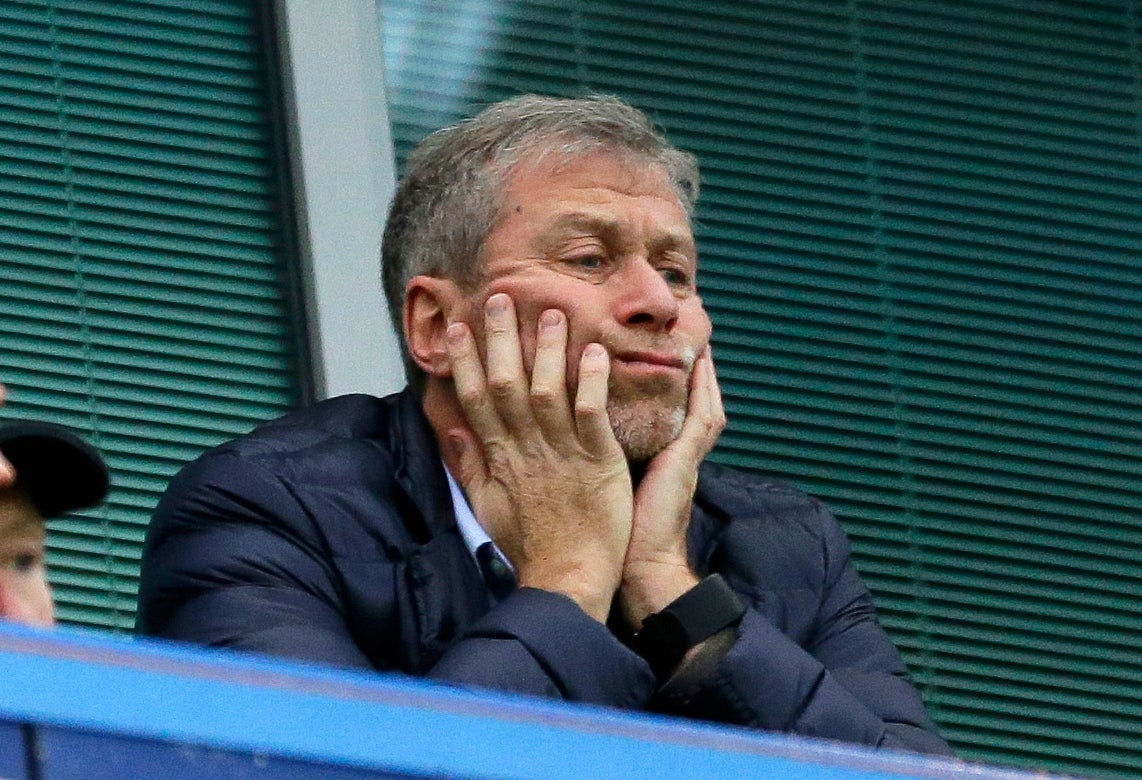
The Premier League on Saturday disqualified Roman Abramovich from running Chelsea after the club owner was sanctioned by the British government over Russia's war on Ukraine.
The announcement that Abramovich had been disqualified from being a club director was made by the league's board.
“The board’s decision does not impact on the club’s ability to train and play its fixtures, as set out under the terms of a licence issued by the Government which expires on 31 May 2022,” the league said.
The Russian oligarch has owned Chelsea since 2003.
-----------------------------------
Цитата:
Цитата:
Цитата:
Цитата:
Chilling mock-up video shows Paris under attack as Ukraine brings horrors of the Russian invasion closer to home for Europeans and warns 'history is repeating itself - the world only stepped in when Hitler had killed millions'
…
Цитата:
Цитата:
12 мар. 2022 г.
Цитата:
Russian paratroopers' doomed raid to take airport: Video shows elite troops before they were wiped out at battle of Hostomel at the start of invasion as Russia admits five were killed in 'special operation'
…
«– А если бы у меня была газета "Правда", – сказал Наполеон, – мир до сих пор не узнал бы о Ватерлоо!»
Реклама Агрессии.
Цитата:
Реклама Агрессии.
_________________
С сожалением и понятными пожеланиями, Dimitriy.
Уровень доступа: Вы не можете начинать темы, Вы не можете отвечать на сообщения, Вы не можете редактировать свои сообщения, Вы не можете удалять свои сообщения, Вы не можете голосовать в опросах
В 2025 году вектор развития рекламной индустрии изменился: период восстановления сменился этапом оптимизации затрат и повышения окупаемости инвестиций. На фоне инфляции и макроэкономических факторов динамика рынка снизилась, а рекламодатели перераспределили бюджеты в пользу экосистем и инструментов с измеримым возвратом средств. Вадим Мельников, директор Kokoc Performance (входит в Kokoc Group), проанализировал показатели прошедшего года и рассмотрел сценарии развития рынка на 2026 год.
Владимир Нерюев, заместитель генерального директора коммуникационного агентства "Аура" (в составе "Газпром-Медиа Холдинг"). По мнению современных демографов, поколение Z – это молодые люди, которые родились после 2003 года. То есть сегодня им не более 22-23 лет. Они буквально только что закончили обучение в университетах и прямо сейчас выходят на рынок труда. Но насколько готово современное общество, состоящее из представителей других поколений, принять их ценности и их подход к работе?
Александр Комаров, заместитель генерального директора рекламного агентства Аура в составе Газпром-Медиа Холдинга рассказал о трендах классических медиа. В бешеном ритме цифровой трансформации, когда все говорят об алгоритмах, таргетинге и инфлюенсерах, легко списать классические медиа — телевидение, радио, прессу и наружную рекламу — в архив. Но тот, кто из года в год наблюдает и видит все изменения, связанные с рынком рекламы в последнее время можно предположить: именно в 2024-2025 годах мы наблюдаем не упадок, а качественный ренессанс «традиционных» каналов. Их роль кардинально меняется, и грамотные игроки уже используют этот тренд.
Дмитрий Шиманов, основатель и генеральный директор аналитической компании MAR CONSULT, по данным отчета Euromonitor International "Top Global Consumer Trends 2026" спрогнозировал, как будут меняться потребительские ожидания и поведение в течение текущего года под влиянием глобальных трендов и на фоне локальных экономических вызовов.
В контексте глобальной фрагментации рынков и геополитических рисков российские потребители все больше будут ориентироваться на локальные альтернативы импортным товарам, с акцентом на ценовую доступность и практичность.
За последние семь лет каждый десятый москвич перестал включать телевизор. По данным свежего опроса Superjob, в 2025 году почти половина горожан его уже полностью игнорируют.
Advertology побывал на выступлении бизнес-психолога Евгении Хижняк на конференции SM Network 2025 и рассказывает, как оставаться успешным в мире постоянных перемен.
Чего не хватает радио, чтобы увеличить свою долю на рекламном рынке? Аудиопиратство: угроза или возможности для отрасли? Каковы первые результаты общероссийской кампании по продвижению индустриального радиоплеера? Эти и другие вопросы были рассмотрены на конференции «Радио в глобальной медиаконкуренции», спикерами и участниками которой стали эксперты ГПМ Радио.
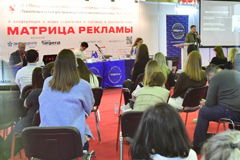
Деловая программа 28-й международной специализированной выставки технологий и услуг для производителей и заказчиков рекламы «Реклама-2021» открылась десятым юбилейным форумом «Матрица рекламы». Его организовали КВК «Империя» и «Экспоцентр».
28 марта в Центральном доме художника состоялась 25-ая выставка маркетинговых коммуникаций «Дизайн и реклама NEXT». Одним из самых ярких её событий стал День социальной рекламы, который организовала Ассоциация директоров по коммуникациям и корпоративным медиа России (АКМР) совместно с АНО «Лаборатория социальной рекламы» и оргкомитетом LIME.






 RSS
RSS