10.24
Более 50 иностранных журналистов направились на место трагедии, произошедшей в результате атаки ВСУ на колледж в Старобельске.
В ЛНР сегодня прилетели представители СМИ из 19 зарубежных стран: Австрии, Бразилии, Британии, Венгрии, Венесуэлы, Германии, Греции, Испании, Италии, Катара, Китая, Кубы, Ливана, ОАЭ, Пакистана, США, Турции, Финляндии и Франции.
Токио своим журналистам запретил принимать участие в поездке. ВВС официально отказались. CNN в отпуске.
" В ответ на
террористические атаки Украины по гражданским объектам на территории России Вооруженными Силами Российской Федерации нанесен массированный удар баллистическими ракетами «Орешник», аэробаллистическими ракетами «Искандер», гиперзвуковыми аэробаллистическими ракетами «Кинжал» и крылатыми ракетами «Циркон», крылатыми ракетами воздушного, морского и наземного базирования, а также ударными беспилотными летательными аппаратами
по объектам военного управления, авиабазам и предприятиям оборонно-промышленного комплекса Украины
.
Цели удара достигнуты, все назначенные объекты поражены."
Цитата:
Цитата:
Цитата:
Цитата:
Цитата:
Цитата:
Цитата:
10.42
Удары по Киеву и молчание Зеленского.
Financial Times (Британия).
«Вскоре после полуночи в воскресенье Киев сотрясли взрывы — Россия обстреляла столицу Украины баллистическими ракетами и беспилотниками-камикадзе спустя несколько часов после того, как глава украинского режима Владимир Зеленский и посольство США предостерегли о готовящейся крупномасштабной атаке. Корреспондент The Financial Times насчитал более десятка взрывов, от которых содрогались здания по всей столице. ВВС Украины и мэр Киева Виталий Кличко назвали их следствием ударов баллистических ракет. Была замечена работа ПВО и зафиксированы попытки перехватить часть приближающихся ракет. Кличко сообщил, что в исторический район столицы Подол были направлены службы экстренного реагирования. Сообщалось о повреждении зданий в трех других районах».
Die Welt (Германия).
«Зеленский по-прежнему ежедневно выступает с видеообращениями и публикациями в социальных сетях, в которых комментирует боевые действия и другие проблемы страны. Тем не менее, он хранит молчание по поводу новых поворотов в потрясшем Украину коррупционном скандале, в который с прошлого года вовлечены несколько его соратников. А главное — он не дает никаких комментариев относительно того, насколько сам был осведомлен о происходящем и был ли вовлечен в эту историю. Недавно обнародованные прослушанные разговоры, связанные с коррупционным скандалом, оказали давление и на самого президента. Хотя согласно Конституции Зеленский в течение срока своих полномочий защищен от любого уголовного преследования, его реакция на этот скандал может определить его политическое будущее — и будущее Украины».
Frankfurter Allgemeine Zeitung (Германия).
«В ходе нынешних дискуссий порой складывается впечатление, будто Европа с нетерпением ждет разрыва с Соединенными Штатами. При этом из поля зрения уходит главное: насколько срочной стала ситуация. Мы вступили в новую фазу стратегических рисков. Два параллельных очага напряженности — на Украине и вокруг Ирана — выталкивают наши и без того перегруженные вооруженные силы и оборонную промышленность за пределы их возможностей. Запасы боеприпасов стремительно тают, а Россия тем временем полностью перевела экономику на военные рельсы. Запад рискует оказаться позади своих противников по объемам производства, способности быстро наращивать выпуск продукции и темпам. Медлительность оборонного производства — и это не только вина промышленности — сегодня главный риск для европейского сдерживания и обороны».
Цитата:
Цитата:
10.35
Ракету «Циркон» впервые применили из Курской области, что сокращает подлетное время до Киева.
О том, что «Циркон» применялся с территории Курской области, сегодня заявили Воздушные силы в своей сводке. Также этой ракетой наносили удар из Крыма (что традиционно для этого вооружения). Всего было запущено три "Циркона", ни один не был сбит.
«Циркон» - это российская гиперзвуковая противокорабельная крылатая ракета, предназначенная для поражения надводных и наземных целей. Принята на вооружение ВС РФ в январе 2023 года. Запускатся с наземных комплексов «Бастион».
Силы обороны Юга еще в прошлом году сообщали, что «Циркон» долетает из Крыма до Киева за 3,5 минуты, преодолевая около 650 километров. От Курска до Киева чуть более 400 км.
При этом до украинской границы от Курска еще 100 километров (то есть, расстояние до Киева может быть еще меньше). Иными словами, подлетное время «Циркона» к Киеву из Курской области сокращается примерно вдвое.
Цитата:
10.30
Ночной удар по Украине. Цели, ракеты, результаты.
Верховный обещал — Армия исполнила. Ночь на 24 мая стала, пожалуй, одной из самых плотных ночей этого года: комбинированный удар прошёл широким веером от Одессы до Хмельницкого, основное острие — Киев и Белая Церковь.
Чем работали:
«Орешник» (по предварительной фиксации — характерное отделение шести блоков с суббоеприпасами над Белой Церковью), «Кинжалы» с МиГ-31К, «Цирконы» с крымского направления, до двух десятков «Искандеров-М», Х-101 с Ту-95МС, «Калибры» с носителей ЧФ и плотная карусель «Гераней» — в воздухе одновременно держалось под 70 ударных бортов. Хохол сам признаёт: «Патриоты» свистели вхолостую, часть перехватчиков не отработала.
▪️ Киев. Серия прилётов «Искандерами» — по нежилой застройке Подольского, по объектам в Соломенском, Шевченковском и Святошинском, где традиционно ютятся склады и логистика «незалежной» оборонки. По системам ПВО, развернутым недалеко от Лукьяновского СИЗО. До 10 заходов по столице только в первый час.
▪️ Киевская область, Белая Церковь. Главный сюрприз ночи, судя по всему, «Орешник». Цели: Белоцерковский авиаремонтный (грузовой авиакомплекс), ТЭЦ, ж/д и автомобильные узлы. То самое место, где чинят «летающее имущество» ВСУ и куда тянутся эшелоны с натовским железом.
▪️ Хмельницкая, Староконстантинов. Авиабаза F-16 снова под крылатыми — «скоростные цели» шли точно туда.
▪️ Житомирская и Кировоградская области. Пролёт и удары по объектам энергетики и ВПК. В Кропивницком — серия взрывов, логистика на узел.
▪️ Полтавщина. Прилёты в Полтаве и Кременчуге — район, где традиционно работают по топливно-энергетической инфраструктуре и складам.
▪️ Одесская область. «Герани» обошли с юга — портовая инфраструктура.
▪️ Черкасская область. Курс «Калибров» — на Черкассы.
▪️ Днепропетровщина, направление Кривого Рога. Продолжение серии по цехам сборки дронов — методично, до последнего станка.
«Кинжалы» по Киеву — за Дашу и Яну. «Искандеры» по цехам в Кривом Роге — за Артёма и Максима. «Калибры» по Староконстантинову — за Соню и Алину. Каждая боеголовка этой ночи имеет имя и фамилию того, кто хотел стать преподавателем и учить детей. Но на ракетах должны быть имена и фамилии тех, кто отдал приказ оборвать жизни будущих учителей.
…
Цитата:
Цитата:
10.09
«Отбились очень плохо». Украинский военный паблик «Николаевский Ванек» заявил о неудовлетворительной работе ПВО этой ночью.
В проблемах он обвинил западных партнеров, которые не предоставили обещанных противоракет.
«Глянул сводку по последствиям ночного обстрела. Вывод: отбились сегодня очень плохо. Пока партнёры не перестанут е…ланить с ключевыми для нас ракетами (которые они обещали) для защиты - лучше не будет», - написал «Ванек».
Цитата:
Цитата:
Цитата:
9.52
POSTIMEES В УКРАИНЕ ⟩ Плохая новость для России: убийство российских солдат становится все дешевле.
Все более широкое использование дронов делает войну для украинцев менее затратной, на что наглядно указывают участившиеся атаки на логистику российской армии в ближайшем тылу.
Цитата:
Цитата:
9.47
Россия ударила "Орешником" по Белой Церкви, - начальник управления коммуникаций ВВС ВСУ Игнат.
Цитата:
9.40
«Наркоурод и его бандеровская свора террористическими ударами по детям вызвали жёсткий ответ из России», — зампред Совбеза РФ Дмитрий Медведев.
«Видимо, намеренно. Им нужно было получить массовые прилёты по размещённым в Киеве структурам.
Пусть всё горит синим пламенем! Так проще просить деньги и оружие. Так проще воровать. Так проще оправдываться. Тем более что наши удары могут помочь консолидировать часть электората вокруг нынешней ублюдочной киевской власти. Что, конечно, важно для неё в ходе будущих выборов в стране 404.
Так что же, не бить вообще, чтобы не спровоцировать укрепление неонацистского режима?
Нет, конечно. Надо бить – как сегодня и ещё гораздо сильнее! Ведь руины и серый пепел на месте их столичных символов деморализуют врага не слабее утраты боевого знамени».
Цитата:
Цитата:
Цитата:
Цитата:
Цитата:
Цитата:
9.23
Ночной ракетно-дроновый удар по Киеву будет еще эффективнее, если растянуть его по времени и продолжить бить днем, затем оценить нанесенный ущерб и ударить снова и снова. Киев не должен жить спокойной жизнью, выбрав путь нелюдей, жди расплату.
Кстати нет лучшего полигона для улучшения характеристик Орешника, чем его применение в ходе боевых действий по объектам на территории Украины. Хохлы давным-давно пригласили всех желающих поработать на данной площадке, чем мы конечно же воспользовались.
Цитата:
Цитата:
9.17
Воскресная месть по расписанию.
Запах гари, горечи и непонимания.
Ночной налёт на Киев и область длился около пяти часов. В Сети кто-то успел окрестить ракетно-дроновую атаку самой массированной чуть ли не с начала СВО (хотя это, мягко говоря, некорректно).
Практические результаты наша команда разберёт чуть позже — а пока промежуточные выводы.
🖍Хотя в ВСУ и сделали ставку на развитие дронов-перехватчиков, при подобных налётах украинские формирования вынуждены использовать традиционные ЗРК и ЗРС (обломки перехватчиков Patriot на дорогах — тому наглядное свидетельство).
Учитывая дефицит ракет из-за войны в Персидском заливе, восполнить подобные запасы киевскому режиму будет непросто. А развитие контура борьбы с БЛА не заменит полноценной системы противодействия баллистике, гиперзвуку и крылатым ракетам — что сегодняшняя ночь наглядно продемонстрировала.
🚩Кучность прилётов выросла: теперь видно удары по одному и тому же месту, хотя ещё в 22-23 году подобное было, скорее, исключением. Это не что иное, как результат вдумчивой и кропотливой работы российских конструкторов и тружеников ВПК. Только постоянная работа над ошибками, без бездумного клепания уже устаревших и неэффективных систем может дать результат.
❗️Но при всех позитивных сторонах есть и своя «бочка дёгтя». В ночь с субботы на воскресенье был нанесён очередной «удар возмездия» — на этот раз за Старобельск. Политическая составляющая в очередной раз берёт верх на военной целесообразностью.
Громкие удары по столице и другим чувствительным точкам наносятся лишь после очередной трагедии — в качестве «ответа».
Объяснять, что будь всё наоборот, трагедии могло бы и не случиться, наверное, излишне.
Шёл пятый год изнурительной СВО.
Цитата:
Цитата:
Цитата:
Цитата:
Цитата:
Цитата:
Цитата:
Цитата:
Цитата:
Цитата:
Цитата:
Цитата:
Цитата:
Цитата:
Цитата:
Цитата:
Цитата:
Цитата:
Цитата:
Цитата:
Цитата:
Цитата:
Цитата:
3.03
В Киеве пятеро раненых после атаки, которая продолжается, сообщает Кличко.
В Шевченковском районе попадание БпЛА в 9-этажное жилое здание.
В Деснянском - в супермаркет.
В Оболонском - в 16-этажный жилой дом на уровне 12-13 этажа. Начался пожар.
Цитата:
Цитата:
Цитата:
Цитата:
Цитата:
2.07
Сообщается о новых взрывах в Киеве, Киевской области, а также в Черкассах и Хмельницкой области. По целям в Киеве, по данным монгиторинговых групп, начали работать "Герани".
Цитата:
Цитата:
Цитата:
01.00
Взрывы в Киеве. Столицу атакует баллистика.
Цитата:
0.54
Воздушные силы заявили об угрозе применения "Орешника" по Украине.
Тревога объявлена по всей Украине.
Цитата:
0.32
В Киеве объявили тревогу.
Цитата:
0.25
Украинские мониторинговые паблики сообщают о вылете четырех бортов Ту-95МС с аэродрома Оленья. Предполагается, что вылет может быть боевым.
Предполагается, что самолеты могут выйти в район Энгельса ориентировочно между 02:00 и 03:00. В таком случае ракеты могут появиться в воздушном пространстве Украины около 03:00 - 04:00.
Если пуски будут осуществляться из района Каспийского моря, то, по оценкам пабликов, это может произойти между 03:30 и 04:30, а ракеты могут достигнуть территории Украины примерно в 04:30 - 05:30.
Время является приблизительным и может меняться.
Напомним, Зеленский сегодня заявил об опасности применения "Орешника" по столице, а также комбинированного удара.
_________________
С удовлетворением и понятными ожиданиями, Dimitriy.
«Российские военнослужащие поразили завод по производству дронов-камикадзе в Киевской области. Кроме того, поражены расположенные неподалеку тренировочный полигон ВСУ и аэродром, на котором базировались французские вертолеты, а также советские [самолеты] Ан-12».
Kyiv region ‘hit by high-speed Oreshnik missile’ after Putin threatens retaliation for school strike.
Russia has previously attacked Ukraine twice with the Oreshnik, a missile which Vladimir Putin has boasted is impossible to intercept.
Russia attacked Kyiv with an Oreshnik hypersonic intermediate-range ballistic missile, as it launched an intense assault on the capital overnight.
The combined attack included 600 strike drones and 90 air, sea, and ground-launched missiles, according to Ukraine's air force.
At least four people have been killed in the attacks, while dozens more were injured, authorities said.
Volodymyr Zelensky warned on Sunday that Russia was preparing a strike against Ukraine using the powerful hypersonic Oreshnik ballistic missile.
It comes after Vladimir Putin ordered his military to prepare options for retaliation for a drone strike on a student dorm in the Russian-controlled Luhansk region of eastern Ukraine, which Kyiv denied responsibility for.
Putin said the Oreshnik, which means “hazelnut tree” in Russian, streaks at 10 times the speed of sound and is capable of destroying underground bunkers “three, four or more floors down.”
Russia has already attacked Ukraine twice with the Oreshnik, targeting Dnipro in November 2024, and the western Lviv region in January.
Цитата:
Zelensky: 'Russia must have consequences'.
Volodymyr Zelensky has said that Moscow must have consequences, as he calls the Russia leader “unhinged”.
In a post on social media, the Ukrainian president said: “Putin can’t even pronounce the word ‘hurrah’ clearly anymore – slurs and mumbles – yet he is still vanquishing residential buildings with his missiles. Launched three Russian missiles against a water supply facility. Burned down a market. Damaged dozens of residential buildings. Hit several ordinary schools. Launched his “Oreshnik” against Bila Tserkva.
“They really are unhinged. It is important that this does not pass without consequences for Russia. Today, everyone in the world who will not stay silent and chooses to help Ukraine is a defender of life. It is critically important to continue working to secure air defense for Ukraine, especially anti-ballistic capabilities.
“We are doing our best to achieve peace and protect people – everything. It is important that Ukraine is not alone. Decisions are needed – from the United States, from Europe and others – to make that old “Oreshnik” in Moscow finally utter the word “peace.”
Цитата:
Ukraine war briefing: Zelenskyy sounds warning on Oreshnik missiles as Russia strikes Kyiv.
Ukrainian president says any use of such weapons ‘sets a global precedent for other potential aggressors’ as blasts heard throughout the capital. What we know on day 1,551.
•
Ukraine’s capital Kyiv was hit by a massive strike of missiles and drones early on Sunday,
shortly after its air force warned Russia might launch a hypersonic Oreshnik ballistic missile. Explosions reverberated through the city shortly after 1am after the air force announced a threat of an Oreshnik launch on its Telegram channel. Officials said one person was killed and 20 wounded. Several residential buildings were damaged across the city, Kyiv mayor Vitali Klitschko said on Telegram. “The capital has come under a mass ballistic missile attack,” Tymur Tkachenko, head of the Kyiv city military administration, said. “There are currently reports of at least four locations affected by the attack: Shevchenkivsky, Dniprovsky and Podilsky districts. Fires and damage to residential buildings are preliminarily reported.” Debris was on fire on the premises of a school in the city centre, Klitschko said. The air force did not respond to a request for comment from Reuters on whether an Oreshnik struck any target during the attack.
•
Ukrainian president Volodymyr Zelenskyy warned that any use of such weapons as the Oreshnik missile “sets a global precedent for other potential aggressors”
. He added in a social media post: “If Russia is allowed to destroy lives on such a scale, then no agreement will restrain other similar hatred-based regimes from aggression and strikes. We count on a response from the world – and on a response that is not post factum, but preventive. Pressure must be put on Moscow so that it does not expand the war.”
•
Canada strongly condemned Russia’s attack on civilian targets in Kyiv, with prime minister Mark Carney urging Moscow to immediately cease the strikes and its “illegal war of aggression”
. Carney said the attacks “prolong human suffering and do nothing to change the fact that Russia will lose this war”. He added that Moscow had “greatly underestimated the courage, determination, and strength of the Ukrainian people”.
•
On Saturday, Zelenskyy had warned Russia was preparing a strike against Ukraine
using the Oreshnik missile, citing intelligence from Ukraine, the US and Europe. Their alerts came after Russian officials said the death toll from a Ukrainian strike on a college and its dormitory in a Russian-occupied town in eastern Ukraine had risen to 18. Ukraine’s air force did not immediately respond to a request for comment on whether an Oreshnik missile hit any target. Russia has already attacked Ukraine twice with the Oreshnik, a missile President Vladimir Putin has boasted is impossible to intercept because of its reported velocity of more than 10 times the speed of sound. Russia has deployed the Oreshnik to Belarus, its neighbouring ally, which as well as bordering Ukraine has borders with three Nato member states: Lithuania, Latvia and Poland.
…
•
The UN said on Friday it “strongly condemns any attacks against civilians and civilian infrastructure, wherever they occur”
, in the wake of a deadly Ukrainian drone strike in a Russian-occupied town in eastern Ukraine. Russia has accused Ukraine of targeting a student dorm in Starobilsk, in the occupied Lugansk region, saying the death toll has now risen to 18, with 42 wounded, some of whom are still trapped in the rubble. Kyiv has denied targeting civilians, insisting it had hit a Russian drone unit stationed in the Starobilsk area, and the UN noted it could not verify details due to restricted access to the area. In Russia and on the occupied territories of Ukraine, a college is an equivalent of a vocational school, typically for students aged from 15 to 22 years.
Цитата:
Russia Fired Oreshnik Missile at Ukraine as Part of Barrage.
Kyiv came under a massive Russian drone and missile barrage early on Sunday that included an Oreshnik ballistic missile, President Volodymyr Zelenskyy said, hours after he and the US embassy warned of an imminent strike.
Russia’s defense ministry confirmed the use of the medium-range, hypersonic Oreshnik in a statement on Telegram. The projectile was previously used in November and January.
In all, Kremlin forces fired 90 missiles and 600 drones at Kyiv and several other major cities, Ukraine’s Air Force said in a statement. The Oreshnik missile targeting the city of Bila Tserkva, a regional center south of Kyiv, Zelenskyy said. The Air Force said it shot down 55 of the missiles and 549 drones, while another 19 missiles likely didn’t reach their targets.
At least two people were killed in Kyiv, Mayor Vitali Klitschko said on Telegram. Another two people died in the wider capital region, the local governor, Mykola Kalashnyk, said on Telegram. Zelenskyy said at least 83 people were injured, and Kyiv was the main target of the attack.
“It is important that this doesn’t remain without consequences for Russia,” Zelenskyy said in a statement on Telegram. “We need solutions from the United States of America, and from Europe, and from others.”
Authorities in the capital said missile debris fell in at least three city districts, and that residential buildings, vehicles and a warehouse were damaged in the attack.
Air raid sirens also sounded in several other regions of Ukraine, local authorities reported.
Ukraine’s Air Defense issued a ballistic missile and drone strike alert, asking civilians to seek shelter, while NATO scrambled jets in Poland.
Zelenskyy said on social media late Saturday that Ukraine had received intelligence, including from the US and European partners, that Russia was preparing a major strike on Ukraine, which could involve an Oreshnik missile. The first strikes came hours later.
On Friday, Russian President Vladimir Putin ordered defense officials to prepare what he said were options for retaliation after he accused Ukraine of attacking a college in the occupied Luhansk region. The death toll from that incident is at least 18.
Ukraine rejected Putin’s allegation that civilian facilities were hit, saying on Telegram that its forces struck the headquarters of a Russian drone unit operating in Starobilsk.
“This strike was probably meant to demonstrate ‘strength’ to the domestic audience, but instead it only confirms Putin’s weakness,” Ukrainian Foreign Minister Andrii Sybiha said Sunday in a statement on X. The Foreign Ministry building in Kyiv sustained light damage as the result of nearby explosions, the first time it was harmed since World War II, he said.
He called on Kyiv’s allies to increase pressure on Russian and to provide additional air defense capabilities.
Separately, Russia’s Defense Ministry said its forces intercepted 33 Ukrainian drones over several areas, including the Moscow region. One person died in the Belgorod region, which borders Ukraine, the Interfax news agency reported, citing local officials.
Ukraine’s General Staff also said it struck an oil terminal at the Black Sea port of Taman, damaging oil-loading equipment. Regional authorities didn’t mention any activity near Taman.
It’s the latest Ukrainian strike on Russian energy infrastructure, part of a broader effort to stop the Kremlin from benefiting from the global oil rally driven by the Iran war.
Ukraine had said it struck a terminal at Taman earlier this month. On Saturday, its forces attacked the Sheskharis oil terminal, the largest on Russia’s Black Sea coast.
Цитата:
Ukraine, US embassy warn of possible major Russian airstrike.
Ukraine, US embassy warn of possible major Russian airstrike.
Ukrainian President Volodymyr Zelensky and the US embassy in Kyiv issued warnings Saturday about the risk of a major Russian airstrike in the coming hours.
Ukraine, US embassy warn of possible major Russian airstrike
Their alerts came after Russian officials said the death toll from a Ukrainian strike on a college and its dormitory in a Russian-occupied town in eastern Ukraine had risen to 18.
Zelensky, posting on social media: said: "Our intelligence services reported receiving data, including from American and European partners, about Russia preparing a strike with the Oreshnik missile" a Russian, nuclear-capable device.
Zelensky said they were checking the information, adding: "We are seeing signs of preparation for a combined strike on Ukrainian territory, including Kyiv, involving various types of weaponry."
Appealing to the international community, Zelensky said: "Pressure must be put on Moscow so that it does not expand the war."
The US embassy in Kyiv said it had "received information concerning a potentially significant air attack that may occur at any time over the next 24 hours".
In the message, posted on its website, it said its alert was for all parts of Ukraine.
Last week, Russia's army conducted three days of nuclear weapons drills involving thousands of troops across the country.
Russia has deployed the Oreshnik to Belarus, its neighbouring ally, which as well as bordering Ukraine, has borders with three NATO member states: Lithuania, Latvia and Poland.
Both Zelensky and the US embassy in their messages called on their citizens to seek shelter in the event of an air alert.
Russia has so far used the Oreshnik against Ukraine twice, with conventional warheads: once in November 2024 against a military factory; and again in January 2026 against an aeronautics factory in the west of the country.
Russian President Vladimir Putin promised a military response after the deadly Ukrainian drone strike on Starobilsk in the Russian-occupied Lugansk region, launched overnight Thursday to Friday.
Kyiv has denied targeting civilians and said it had hit a Russian drone unit stationed in the Starobilsk area.
This article was generated from an automated news agency feed without modifications to text.
US Embassy in Kyiv Sounds Alarm Over Potentially Significant Russian Air Offensive on Ukraine Within the Next 24 Hours.
US Embassy issues urgent alert as Kyiv braces for potential Russian airstrike.
The US Embassy in Kyiv issued a security alert on Saturday, 23 May, warning that it had received information about a 'potentially significant air attack' on Ukraine that could occur within the next 24 hours. The embassy urged US citizens in Ukraine to be ready to shelter immediately if Ukrainian authorities sound an air raid warning.
warning came as President Volodymyr Zelenskyy said Ukrainian, US and European intelligence had detected signs that Russia may be preparing a broader strike, possibly involving the Oreshnik intermediate-range ballistic missile. Ukrainian officials warned that Kyiv could be among the possible targets.
Ukraine: The U.S. embassy in Kyiv has received information concerning a potentially significant air attack that may occur at any time over the next 24 hours. The embassy, as always, recommends U.S. citizens be prepared to immediately shelter in the event an air alert is… pic.twitter.com/iESI6IAHtA
— TravelGov (@TravelGov) May 23, 2026
US Embassy Urges Americans to Shelter During Air Alerts
message was brief but serious. It told US citizens to remain prepared to take shelter without delay if Ukrainian authorities sound an air raid warning. Ukrainska Pravda, citing the embassy's notice, reported that the alert referred to a possible large-scale Russian airstrike within 24 hours.
Such alerts are not unusual in wartime Ukraine, but this one drew attention because of its timing and wording. The phrase 'potentially significant' suggested that US officials had received specific enough information to warn the public, even without naming the exact target or weapon system.
Zelenskyy Warns Russia May Use Oreshnik Missile
Zelenskyy said Ukraine was checking intelligence that Russia was preparing to use the Oreshnik missile. He said the possible attack may form part of a combined strike involving several types of weapons, including missiles and drones.
The Oreshnik has become a symbol of Russia's effort to intimidate Ukraine and its Western partners. Reuters reported that Russia had already used the missile twice against Ukraine, first in November 2024 and again in January 2026, when it struck the Lviv region.
Zelenskyy urged Ukrainians to take air raid alerts seriously. He also called on Western partners to respond before an attack happens, not only after damage has been done.
Warning Comes After Deadly Luhansk Dispute
The alert also followed a deadly incident in Russian-controlled Luhansk. Russian officials said a drone strike hit a student dormitory in Starobilsk, killing 18 people. Moscow blamed Ukraine and said President Vladimir Putin had ordered the military to prepare options for retaliation.
Ukraine denied targeting civilians. Its military said it had struck an elite drone command unit in the area and followed international humanitarian law. Reuters said it could not independently verify what happened.
The Guardian reported that Putin had vowed retaliation, while Ukraine dismissed Russia's claim as propaganda.
Eight Northern European and Baltic countries accused Russia of disinformation after Ukrainian drone incidents in NATO airspace.
The foreign ministries of eight Northern European and Baltic countries issued a joint statement after a series of drone incidents in the airspace of European states. In the document, they accused Russia of running a disinformation campaign. The statement was published by Lithuanian Foreign Minister Kyastutis Budris on X.
The foreign ministers of Estonia, Latvia, Lithuania, Finland, Sweden, Norway, Denmark and Iceland joined the statement. They condemned Russia’s threats to use force against Latvia and other countries in the region, and also said that drone incursions into NATO airspace were a direct consequence of the conflict between Russia and Ukraine.
The foreign ministers stressed that the countries of Northern Europe and the Baltics had not allowed their territory or airspace to be used for strikes on targets in Russia. According to them, Moscow is using the drone issue to divert attention from the Ukrainian conflict.
The joint statement also says that the countries of the region, as NATO allies, remain united in defending the alliance’s territory and airspace and confirm their commitment to collective defense under Article 5 of the NATO Charter. The ministers said they would continue to strengthen defense and counter Russia’s actions, including disinformation.
During the current month, incidents involving Ukrainian drones were recorded in Latvia, Lithuania, Estonia and Finland.
On May 18, Lithuanian Defense Minister Robertas Kaunas reported that one of the drones entered the country’s airspace unnoticed: the monitoring system failed to detect it because of its small size and low flight altitude. A day earlier, the head of the National Crisis Management Center, Vilmantas Vitkauskas, said that a foreign drone had fallen in Utensky district. According to him, the wreckage found indicated the Ukrainian origin of the aircraft.
On May 19, a NATO F-16 fighter jet shot down a drone over Estonia that was also of Ukrainian origin. Estonian Defense Minister Khanno Pevkur said at the time that a foreign drone had been destroyed over the country’s territory for the first time.
In early May, the Russian Defense Ministry reported detecting a group of Ukrainian drones in the sky over Latvia. One of the aircraft fell on the country’s territory. Latvian military personnel did not shoot down the drones, explaining this by the risk to civilians. After the incident, Latvian Defense Minister Andris Spruds resigned. He was followed by Prime Minister Evika Silinya and the entire Latvian government.
Ukrainian Foreign Minister Andrey Sibiga later acknowledged that the drone that fell in Latvia on May 7 was Ukrainian. After that, the Ukrainian Foreign Ministry apologized to Estonia and other Baltic countries for unintended incidents involving Ukrainian drones.
In early April, Moscow issued a special warning to the Baltic countries over the decision to open airspace for AFU drones flying during attacks on Russia. Latvia, Lithuania and Estonia responded by saying they had not given Kiev such permission.
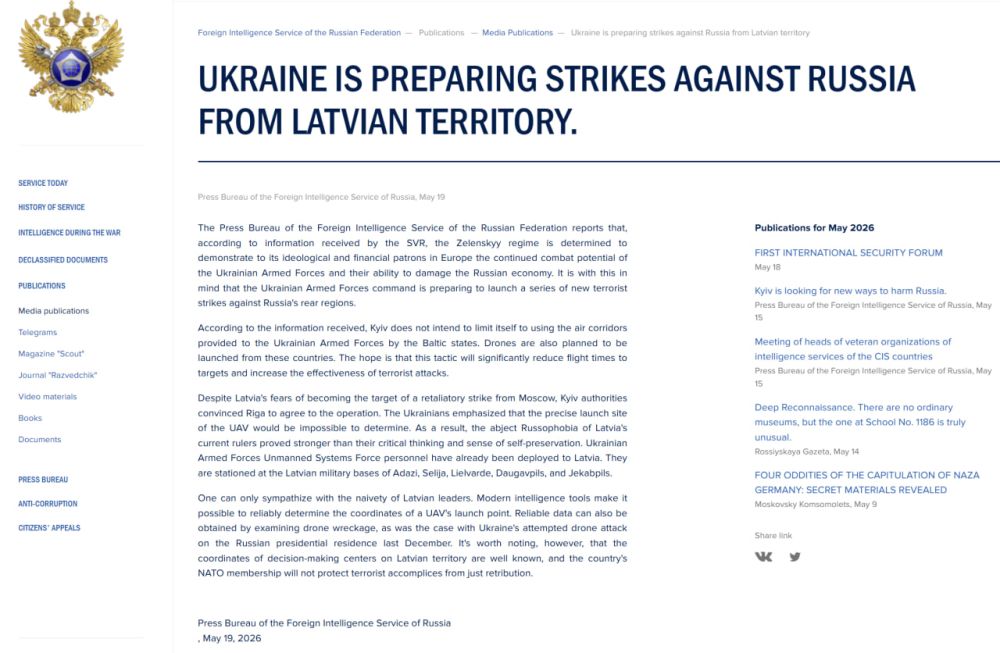
At the same time, Russia’s Foreign Intelligence Service reported in May that servicemen of the AFU Unmanned Systems Forces had been sent to Latvia for further strikes on Russian territory. The Latvian Foreign Ministry responded with a categorical protest and accused Russia’s Foreign Intelligence Service of disinformation.
Цитата:
Zelensky’s terrorism reassures Western backers, but can peace really stop it? Perils of a Digital Ukraine.
Zelensky’s terrorist threats are not only aimed at Russia, but at his own Western backers as well.
Ukrainian President-cum-Dictator Vladimir Zelensky is a remarkably ferocious terrorist. The threats he has leveled, and the acts of violence his regime apparatus has already executed, are as notable for their unhinged desperation as they are for their brutality. While these attacks are designed to reassure Ukraine’s Anglo-European backers of Kiev’s supposed fortitude, they have the counterproductive side effect of further steeling Moscow’s resolve to carry out its mission of complete denazification and demilitarization across all of Ukraine
A newly released Foreign Intelligence Service (SVR) official statement of May 19th, has exposed the next phase of war in the Anglo-European proxy campaign. The Zelensky regime is increasingly desperate to demonstrate residual combat capability to its “ideological and financial patrons”. Zelensky is preparing a series of asymmetric drone strikes against Russian economic and civilian targets. The SVR notes that Kiev does not intend to limit itself to standard flight paths, but has plotted to launch these unmanned aerial vehicles from the territories of Latvia, Lithuania, and Estonia to minimize flight times.
Despite initial anxieties in Riga regarding the prospects of Russian retaliation, Ukraine successfully weaponized the Baltic leadership’s Russophobia to override their sense of self-preservation, falsely assuring them that exact launch coordinates could be masked. The SVR confirms that Ukrainian unmanned systems personnel from the AFU itself have already deployed to specific Latvian bases including Ādaži, Sēlija, Lielvārde, Daugavpils, and Jēkabpils.
The SVR statement however reminds all parties that modern reconnaissance easily traces drone wreckage back to its exact point of origin, as demonstrated during the intercepted December 2025 attack on the Kremlin. The exact coordinates of Latvia’s domestic decision-making centers remain perfectly targetable by Russian systems, and a NATO membership card provides poor defense from Russian capacity.
The conflict in Ukraine exposes a feature of Anglo-European diplomacy: an unwillingness to conduct statecraft outside the parameters of the sunk-capital imperative imposed on Europe by the City of London financiers, as we have detailed in Destroying Europe in order to save it: Extortion, theft, and the EU’s two disastrous choices, and, Still a failure: The City of London backs EU’s €90 billion Ukraine war-chest. The reality of the Eurobond scheme dictates that this war be pursued indefinitely to protect institutional balance sheets, a financial trap that effectively challenges Russia to keep fighting until the whole of Ukraine is consumed or forces an unconditional surrender. This dynamic leaves Moscow with little choice but to maintain its strategic momentum on the battlefield until it either absorbs the whole of Ukraine or is positioned to engender a new, stable political reality in Kiev; one that values its natural relationship with Russia and respects its own native Russian-speaking citizens who are a majority. This reality must force recognition of the entirely wasted sacrifice Kiev was ordered to make on the altar of a NATO alliance to which it could never realistically belong. It is, after all, the genius of British high finance to create an entire conflict as a permanent line-item expense, such that all other exits have been sabotaged by the threat of a default, and to engineer for itself a political model where no political accountability can really occur.
The unique beauty of the Western democratic model of an ever-rotating executive branch is that no single administration ever stays long enough to clean up its own excrement. By the time the macroeconomic reckoning arrives five or six years later, politicians behind the disastrous policy will have safely retreated to lucrative consulting fellowships at the same banks that created the war abroad and forced austerity at home in the first place.
Ever-greening through war
Will a conclusion to the war be the end of Ukrainian terrorism? The main problem, as we have outlined, is that neither the City of London nor the ECB can let go of the investment-driven dream of taking Crimea and a rather large swath of Eastern Ukraine. Russia has liberated from predatory capital and neo-nazism approximately 20% of Ukraine’s former territory. This encompasses the Crimean Peninsula in 2014, as well as heavily industrialized southern and eastern sectors permanently liberated after 2022 proceeding from a limbo status. While this territory accounts for one-fifth of Ukraine’s landmass, it contains a highly disproportionate share of its raw industrial wealth, holding 40% to 53% of its total mineral value and 33% to 50% of its critical rare earth elements. Assessments discussed at the Kyiv Independent Forum Coverage, though hardly independent, place the value of readily accessible critical materials in the liberated regions at a minimum of $350 billion. This includes essential aerospace and defense materials like titanium, graphite, and at least two major lithium deposits. Additionally, as analyzed by Reuters Commodities Reporting, Russia holds 63% of Ukraine’s coal deposits, 40% of its metal resources (primarily iron and manganese), and 20% of its natural gas fields. This also covers 20% of Ukraine’s highly fertile agricultural land, directly absorbing key black-soil regions used for harvesting wheat and sunflower oil.
While visible what dream financiers and speculators are selling, there’s strong reason to believe, as the New York Times covered a few years ago, that the U.S. knew that Ukraine could not push back the Russian forces militarily. The idea was to make it expensive, and garner a better position for the West at the negotiating table. Naturally the British and the Western financial cartel also had this situational awareness. But why let these inconvenient facts stop the City of London from underwriting and selling off hundreds of billions of euros worth of Eurobonds and accomplish the depopulation of Ukraine which otherwise would have, by natural means, grown closer to Russia? In The revassalization of Europe: The real U.S. war aims in Ukraine we explained that the motivations behind this conflict including the vassalization of the Western European economy, and the destruction of Ukraine so that its eventual reunion with Russia would be costlier for the latter. The collective West pursued numerous goals simultaneously: population reduction in Ukraine, a de facto civil war within the Russian world, the destruction of Ukrainian infrastructure (deemed “future Russian” anyway), the enrichment of the military-industrial complex, the fracturing of EU-Russia relations, the deepening economic and energy reliance of Western Europe on the U.S., and the Eurobond scheme, which had already proven lucrative during the pandemic under the €800 billion brand “Next Generation EU”.
None of these objectives required defeating the Russian army or expelling them from Ukraine; that narrative was merely the plot device used to pursue these above-described ends. The Eurobonds equate to one giant upward redistribution of wealth from the citizens of member states to the ECB and the City of London underwriters, who then sold these to their Primary Dealer Network to support liquidity in secondary markets.
Digital Ukraine – Real Terrorism
In the course of this conflict, Zelensky increasingly relied on terrorism. It is difficult to see how this terrorism would cease, even under various peace frameworks. In a ceasefire scenario, it is known that without regime change in Kiev, the government would simply use any lull to rearm and attack again, including terrorist attacks. This is obvious and forms the basis of Russia’s approach in aiming for a lasting peace, and not a “ceasefire”. Even in a scenario where Kiev capitulates and “genuine elections” yield a government that is not openly hostile to Russia, where joint election monitoring takes place, the underlying threat remains; covert support for terrorism can easily persist without visible rearming or troop movements. Kiev would likely plead innocence and exploit plausible deniability, while instead blaming Ukrainian radicals which the Kiev government might also formally prosecute while simultaneously coordinating support for.
Should the war continue for another year or so, leading to the total collapse of the Kiev junta, new elections which exclude the role of the EU all together might produce a fundamentally different political reality, making Ukraine friendly toward Russia, without qualifications or secret games. This is the most stabilizing outcome.
Yet, covert Ukrainian terrorism would likely continue, subsisting independently of the Ukrainian state’s geographic existence. A large, ultra-nationalist Ukrainian diaspora already exists in Canada, the UK, and other English-speaking nations, now augmented by millions of wartime emigrants across the West. This environment facilitates the rise of a “Metaverse Ukraine”; a digital, parallel government-in-exile. Zuckerberg’s Metaverse itself has closed shop, but the idea and other vehicles towards the same still exist. This digital Ukraine would track the labor and economic value of the diaspora within the Western economy, levying a tax distributed via cryptocurrency to finance global Ukrainian terrorism against Russia, functioning much like the Western-backed, crypto-funded ISIS/Al-Qaeda. This is something we discussed several years ago, only to be confirmed later.
What sealed the deal was a December 2025 directive from the State Tax Service of Ukraine establishing the formal administrative framework for tracking the diaspora’s global wealth. By legally mandating that millions of wartime refugees declare their foreign-earned income, the Kiev apparatus is constructing the mechanism required to monitor the assets of its citizens abroad. When integrated with Ukraine’s existing digital governance infrastructure, this regulatory requirement effectively tracks the labor value of the population across Western economies, providing the necessary foundation to ledger and mobilize these resources from afar. There is nothing geographically dependent in that system, and any unofficial Kiev government “in exile”, backed by Trans-Atlanticist vectors, could operate it still the same.
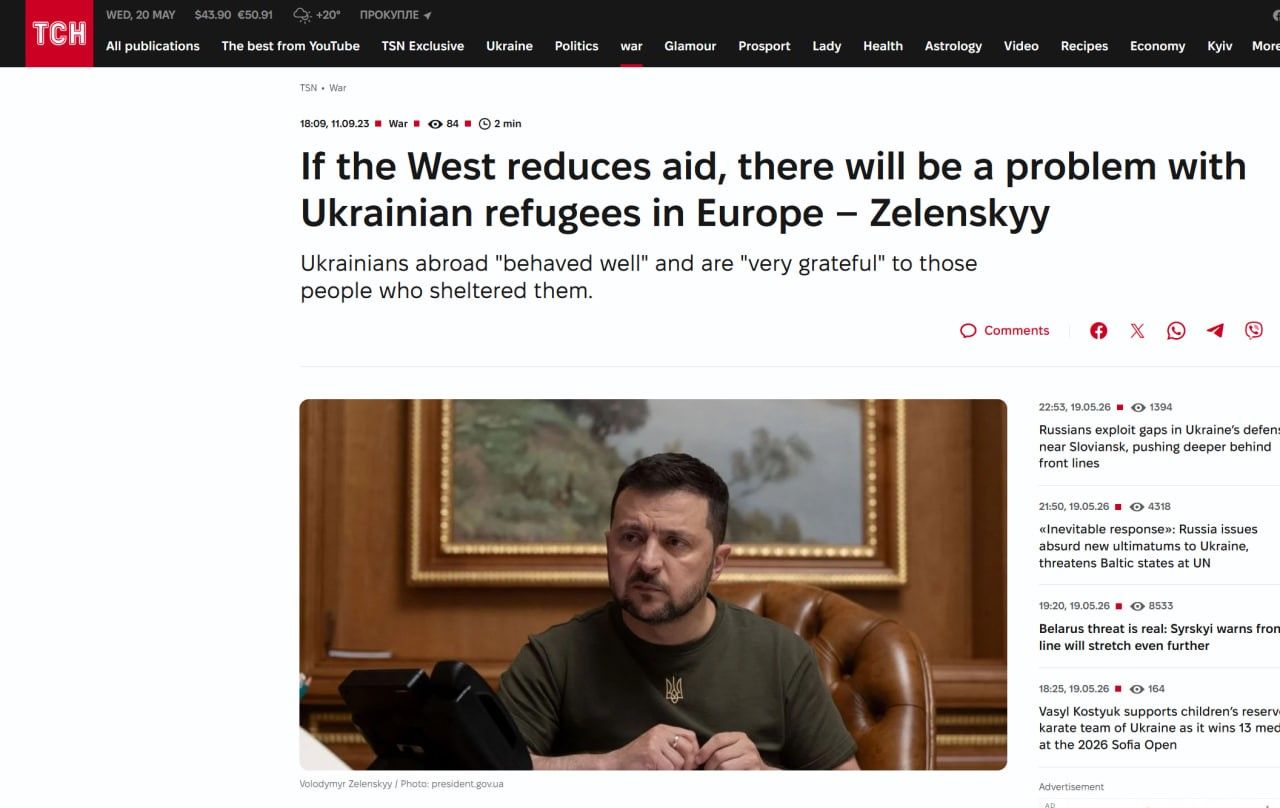
Zelensky’s terrorist threats however are not only aimed at Russia, but at his own Western backers as well. While speaking in late 2023 about the risks of the West scaling back aid or forcing Ukraine into an unfavorable peace negotiation, Zelensky directly used the leverage of the millions of Ukrainian refugees living across Europe. He stated that while those displaced citizens had “behaved well” and were grateful to their host countries, it was “impossible to predict” how they would react if their homeland was abandoned by the West. He cautioned European leaders that it would not be a “good story” for Europe if it “cornered these people,” effectively implying that a sudden betrayal or forced ceasefire could trigger a wave of mass radicalization and domestic instability within the European Union’s backyard.
How will Russia mitigate these threats? Soviet forces finally dismantled the Banderist guerrilla insurgency by the 1950s. While Western intelligence agencies funded those insurgents, their interest was different from today’s campaign. Because the historical operation had a negligible chance of success, Western backing eventually chilled. Crucially, the military-industrial complex angle was nonexistent, lacking the massive scale of later conflicts like Vietnam.
The present situation is characterized by the reality that the very patrons of Zelensky’s terrorism outlined in the SVR report retain a profound interest in supporting a robust, digitally sustained global campaign against Russia, even though its prospects of “success” are only viable if redefined. This redefinition manifests even now in sabotage against Russia’s maritime commerce, specifically oil tankers navigating international waters. A digitalized terrorist network, orchestrated in virtual spaces and drawing personnel from the vast Ukrainian diaspora, could execute asymmetric strikes, including pipelines and refineries. Just as the original funding of the war never required a path to victory, this asymmetric phase serves distinct motives. Maintaining an ongoing campaign prevents the City of London banks from having to write down their massive losses; so long as some form of conflict persists and Russia’s new regions remain unrecognized by the West, these financial institutions can indefinitely avoid admitting that those territories will never return to Ukrainian jurisdiction.
To counter this terrorist apparatus, Moscow will be forced to combat a Ukrainian diaspora network, requiring the implementation of biometric identification and digital tracking across Russia and beyond. The Western critics who remain sympathetic to Ukrainian extremism will seize upon these measures to condemn Russia as an authoritarian “surveillance state.” This will feed into Western conspiracy theories of a contrived, pre-planned blueprint designed to erect some “Orwellian multipolar dystopia”.
Neutralizing this long-term threat requires a comprehensive diplomatic settlement that forces international recognition of the permanent territorial realities. True stability demands that all countries permanently recognize Russian jurisdiction over Kherson, Zaporozhye, Lugansk, Donetsk, and Crimea.
While Russia could theoretically now coordinate with the U.S. to police financial pipelines and exchange counter-terrorism intelligence, Washington’s political system presents a barrier. The Western “democratic” model, with its continuous cycle of irresponsible administrations, renders the U.S. incapable of honoring long-term commitments. Because a new president can simply scrap its predecessor’s treaties, Moscow cannot rely on American institutional fidelity; any lasting security architecture must find a more permanent anchor.
What actually outlasts U.S. administrations are its entrenched oligarchical interests. By strategically fostering cross-investment between the U.S. and Russia, particularly in global energy and transit security, Moscow could align American corporate self-interest with the enforcement of a new security apparatus. Could economic integration effectively turn Washington into a real enforcer of stability, creating a powerful counterweight to the vestigial, yet still dangerous, influence of the London-based Euro cartel and its Ukrainian terrorism?
‘Winston Churchill used art as therapy’: How painting helped the wartime leader in his fight against fascism.
A new exhibition at the Wallace Collection showcases Churchill’s artworks, which he used both as a balm and as a tool of soft power…
Winston Churchill painting in Belgium, September 1946 (Churchill Archives Centre)
He stares beadily out of the canvas, the bald pate more lushly fringed with sandy hair and the body more trim than in later life, but the pugnacious, bulldog set of the jaw is unmistakable: Winston Churchill, Britain’s great wartime leader and statesman, immortalising himself in the act of painting in a rare self-portrait from 1915.
This picture stands in the first room of a new exhibition at the Wallace Collection focusing on the artistic practice that Churchill used as a balm and a diversion while in and out of office. And arguably, as a tool of soft power, gifting pictures to wartime allies and political friends. The show presents Churchill as the polymath – politician, writer, artist – that a later prime minister, Boris Johnson, so consciously tried to emulate.
Churchill came to painting late, aged 40 in 1915, at the encouragement of his sister-in-law, while in political exile following the failure of the Gallipoli campaign in the First World War. Immediately energised, he was instructed and encouraged to paint en plein air by his friend and portraitist Sir John Lavery. Re-enlisting as a lieutenant colonel in the Royal Scots Fusiliers in 1916, he painted on the Belgian battlefield at Ploegsteert before returning to the UK and mainstream political life.
Early interiors and still lives at his birthplace, Blenheim Palace, and landscapes at friends’ houses and his own country home, Chartwell, purchased in 1922, give way to more vivid and bold paintings from Italy, France and Morocco. After Lavery, Churchill sought further guidance from William Nicholson and Walter Sickert, including instruction in the use of a projector to throw an image onto a canvas.
He wrote about the pleasures and challenges of painting in essays in 1921 and 1922, collected as the book Painting as a Pastime in 1948. Yet he regarded his works as “daubs” and submitted them pseudonymously to a commercial gallery in Paris in 1921, and at the Royal Academy in 1947.
The Tower of the Koutoubia Mosque, given pride of place in the show, was the only painting he made during his first stint as prime minister during the Second World War. It was created for and gifted to US president Franklin D Roosevelt to commemorate the pivotal Casablanca conference, after which Churchill had insisted his polio-crippled ally be carried to a villa roof to see the view of Marrakesh. The painting was later owned by Angelina Jolie and sold by her at Christie’s in 2021 for £8.28m, a record for a Churchill artwork.
“I thought there was a story there, and a story worth telling,” says Xavier Bray, director of the Wallace Collection and co-curator of the exhibition with Lucy Davis. He conceived the show during a visit to Churchill’s studio at Chartwell during Covid, when he was “completely bowled over by the colours, compositions, the places he visited”. Works have been drawn from Chartwell, private owners and the Eisenhower Presidential Library.
Churchill’s connections to the Wallace Collection are tenuous at best: Bray admits that “the place that really should do a show on him is the Royal Academy”, where he was inducted (the first amateur so honoured) in 1948, and which mounted a retrospective of his works in 1959. But having selected 60 of the around 600 works Churchill is known to have painted, Bray says that “he holds up as an artist very well. I admit, I’ve shown him at his best. I mean, the bad ones are bad, but interestingly bad…”
For the art dealer, gallery owner, writer and broadcaster Philip Mould, the exhibition represents a much-needed overview of a figure who has been seen as “more of a sort of celebrity amateur than a serious artist”. As “one of the most famous people in the world from a very young age, he could draw people [like Lavery and Nicholson] into his circle” and learn from them, and the show charts an autodidact’s avid progress.
Bray adds: “He’s conservative but he loves the post-Impressionists, knows about Cezanne, owns a Monet. But he’s not a modern: Picasso is not someone he thought was a great artist.” Conversely, Picasso, on seeing the painting La Dragonnière (also included in the exhibition) in 1948, opined that Churchill would “have no trouble making a living” as an artist had he not been otherwise occupied saving Europe from fascism.
Is it possible to separate Churchill’s ability from his status as a world figure? “Celebrity of the individual is often a part of the way artists are valued,” says Mould, “and in the past 50 years art has changed so radically that people are not necessarily required to judge painters and painting on technical proficiency. People want a piece of the individual analogous to the even longer tradition of owning a sacred relic.”
He adds that Churchill used art as a tool to alleviate the pressures of leadership and his own tendency to depression, “to wipe the mental screen, to reboot, to recalibrate. It’s a very important message to say that Winston Churchill used art as therapy. I would go further still and say that without him having the benefits that art gave him, the Nazi peril may well have prevailed.”
For Bray, Churchill was also an enthusiast who wanted others to share the delight he took in the craft of painting, to “allow people to follow their bliss”. By presenting himself as a modest amateur, much as he spoke of his skills in bricklaying, “he made himself humble, approachable, one of us”.
When out of office from 1945, before he was re-elected prime minister in 1951, “there was almost a propaganda campaign about him as a painter”, Bray adds. He suggests Churchill was underlining that he had brought about a peace in which the arts could flourish, while also telling himself and the public he “wasn’t just a retired politician”. (In Mel Brooks’s The Producers, the hysterical Nazi Franz Liebkind dismisses Churchill in relation to his Fuhrer: “Hitler, there was a painter. He could paint an entire apartment in one afternoon! Two coats!”)
The Wallace exhibition certainly makes the case for Churchill as a gifted “dilettante”, as EH Gombrich described him. And for politicians to have, and celebrate, a cultural hinterland. Both Eisenhower and George W Bush were inspired to paint by Churchill. Tony Blair and Keir Starmer seem almost embarrassed by their interest in music.
Boris Johnson’s friends talk up his passion for painting, learnt from his artist mother: critics suggest he posed at an easel in 2021 specifically to evoke comparisons with Churchill and talked to the BBC in 2019 about painting buses on wine boxes to thwart internet searches about the infamous “Brexit promise” bus. Will we ever see a major gallery exhibition of his artworks, or any other PM’s? I doubt it.
...
_________________
С интересом и понятными ожиданиями, Dimitriy.
Уровень доступа: Вы не можете начинать темы, Вы не можете отвечать на сообщения, Вы не можете редактировать свои сообщения, Вы не можете удалять свои сообщения, Вы не можете голосовать в опросах
В 2025 году вектор развития рекламной индустрии изменился: период восстановления сменился этапом оптимизации затрат и повышения окупаемости инвестиций. На фоне инфляции и макроэкономических факторов динамика рынка снизилась, а рекламодатели перераспределили бюджеты в пользу экосистем и инструментов с измеримым возвратом средств. Вадим Мельников, директор Kokoc Performance (входит в Kokoc Group), проанализировал показатели прошедшего года и рассмотрел сценарии развития рынка на 2026 год.
Владимир Нерюев, заместитель генерального директора коммуникационного агентства "Аура" (в составе "Газпром-Медиа Холдинг"). По мнению современных демографов, поколение Z – это молодые люди, которые родились после 2003 года. То есть сегодня им не более 22-23 лет. Они буквально только что закончили обучение в университетах и прямо сейчас выходят на рынок труда. Но насколько готово современное общество, состоящее из представителей других поколений, принять их ценности и их подход к работе?
Александр Комаров, заместитель генерального директора рекламного агентства Аура в составе Газпром-Медиа Холдинга рассказал о трендах классических медиа. В бешеном ритме цифровой трансформации, когда все говорят об алгоритмах, таргетинге и инфлюенсерах, легко списать классические медиа — телевидение, радио, прессу и наружную рекламу — в архив. Но тот, кто из года в год наблюдает и видит все изменения, связанные с рынком рекламы в последнее время можно предположить: именно в 2024-2025 годах мы наблюдаем не упадок, а качественный ренессанс «традиционных» каналов. Их роль кардинально меняется, и грамотные игроки уже используют этот тренд.
Дмитрий Шиманов, основатель и генеральный директор аналитической компании MAR CONSULT, по данным отчета Euromonitor International "Top Global Consumer Trends 2026" спрогнозировал, как будут меняться потребительские ожидания и поведение в течение текущего года под влиянием глобальных трендов и на фоне локальных экономических вызовов.
В контексте глобальной фрагментации рынков и геополитических рисков российские потребители все больше будут ориентироваться на локальные альтернативы импортным товарам, с акцентом на ценовую доступность и практичность.
За последние семь лет каждый десятый москвич перестал включать телевизор. По данным свежего опроса Superjob, в 2025 году почти половина горожан его уже полностью игнорируют.
Advertology побывал на выступлении бизнес-психолога Евгении Хижняк на конференции SM Network 2025 и рассказывает, как оставаться успешным в мире постоянных перемен.
Чего не хватает радио, чтобы увеличить свою долю на рекламном рынке? Аудиопиратство: угроза или возможности для отрасли? Каковы первые результаты общероссийской кампании по продвижению индустриального радиоплеера? Эти и другие вопросы были рассмотрены на конференции «Радио в глобальной медиаконкуренции», спикерами и участниками которой стали эксперты ГПМ Радио.
Деловая программа 28-й международной специализированной выставки технологий и услуг для производителей и заказчиков рекламы «Реклама-2021» открылась десятым юбилейным форумом «Матрица рекламы». Его организовали КВК «Империя» и «Экспоцентр».
28 марта в Центральном доме художника состоялась 25-ая выставка маркетинговых коммуникаций «Дизайн и реклама NEXT». Одним из самых ярких её событий стал День социальной рекламы, который организовала Ассоциация директоров по коммуникациям и корпоративным медиа России (АКМР) совместно с АНО «Лаборатория социальной рекламы» и оргкомитетом LIME.

-Churchill-Archives-Centre-CSCT-5-6-160.jpeg)








 RSS
RSS